Dec 21, 2010

Why is karaoke so popular in the Philippines?

Dear Filipino,

Why is karaoke so popular around here [Philippines]? I can't sleep at night without hearing sintunado [out of tune] singing and it's starting to be a little annoying.

Chloe S.

Dear Chloe,

When I saw the word "karaoke" in your question, the first words that came to my mind were:

Why do you build me up (build me up) Buttercup, baby
Just to let me down (let me down) and mess me around
And then worst of all (worst of all) you never call, baby
When you say you will (say you will) but I love you still
I need you (I need you) more than anyone, darlin'
You know that I have from the start
So build me up (build me up) Buttercup, don't break my heart! 
Sorry, I couldn't help it!  As if on cue, the music by The Foundations just flooded my brain.  You're lucky actually -- if we were face to face, you'd have seen me dance and snap my fingers to the tune too!

So yes -- I feel for you.  It would be torture for anyone to see and hear someone like me sing (and dance!) to karaoke non-stop, which I'm capable of doing!  Honestly, I just hope you're not the type who goes postal and murderous just because someone is belting Frank Sinatra's My Way -- truly a disturbing and bizarre trend. 

But why do Filipinos love to sing karaoke?

The easy, short, obvious and very much correct answer is: Because we love music.

But there's an even better explanation: Because we actually invented karaoke singing.  Literally.

While the Japanese are the ones credited for coining the term "karaoke" (from "kara" meaning empty and "ōkesutora" meaning orchestra), it was actually a Filipino, Roberto del Rosario, a gifted musician and music teacher, who developed in 1975 (and later patented) an advanced sing-along-system known as OMB (one-man-band) which was the combination of a music player, voice taping mechanism, tuner and mixer -- a sing-along-system (SAS) which allowed his students to sing with the recorded music using a microphone and an amplified speaker.

I must point out though that there are disputes as to who really invented karaoke.  One version says it is actually Daisuke Inoue who invented karaoke in 1971 even if he failed to patent it.

But I don't completely buy it.  Here's why:

Tracing the history of Filipino workers through the centuries in Japan, Prof. Lydia N. Yu-Jose of Ateneo de Manila noted that "[w]hile most [of the original] Filipino migrant workers in the United States were plantation laborers, most of the workers in Japan...were musicians."  Their earliest recorded presence was in 1886, but the entry of Filipinos in Japan became more regular in the 1920s and onwards, mostly as members of "real" American jazz bands.  After World War II, their presence only increased, initially due to the fact that American managers and promoters were recruiting them to perform in American bases in Okinawa.  But then, Prof. Yu-Jose noted, these same recruited Filipinos would later find themselves performing in fashionable night clubs of Tokyo, outside the oversight of course of their American overlords.  

Needing to improvise, Filipinos came up with low-tech but clever solutions that would generate greater revenue for them at a cost lower than having a full-scale musical band (like the American-owned and American-managed ones from which they started).  These improvisations eventually led to the development of 'minus-one music' - a sing-along musical accompaniment recorded on cassette tapes which also became prevalent in the Philippines from the late 1960s to the early 1980s. 

In other words, even assuming for the sake of argument that Daisuke -- who did not patent his invention -- did indeed beat del Rosario -- who patented his (leading to his later being awarded a Gold Medal for Best Inventor in 1985 by the United Nations World Intellectual Property Association) -- to the "race," one can legitimately argue that Filipinos, collectively as hired musicians in Japan, were actually the ones who really came up with the first beginnings of the karaoke system.

In any case, back to your question.

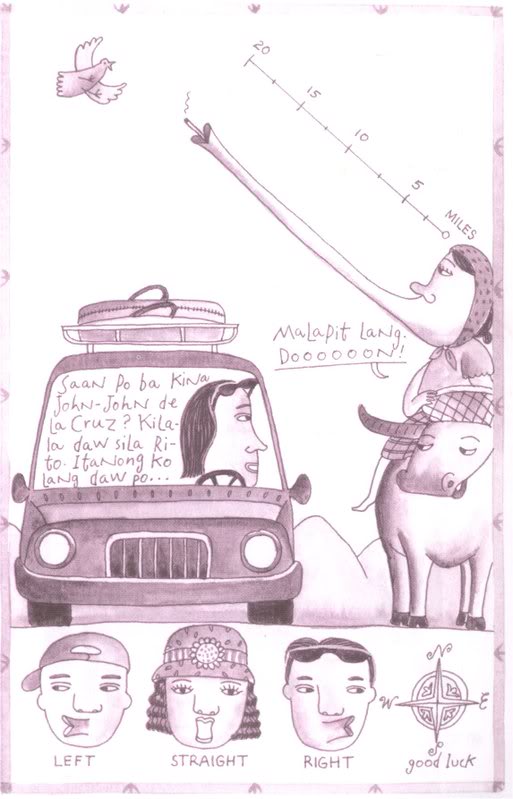
You said it's getting to be annoying, so I came up with a matrix which you can distribute to your family, friends, and officemates, and/or post in karaoke parlors to help guide people on the proper etiquette for karaoke singing:


Personally, I'm a 2: I'm kinda sintunado and I know it for a fact.  But I sing karaoke because I really just wanna have fun.  The tricky part for me, of course, is not knowing whether I'm overdoing it or not.  That's where my true friends come in, who always forcibly yank away the microphone from me.

Anyway, if we chance to meet each other one day at a karaoke parlor and you want to strangle me already about my karaoke singing, will you please wait until you hear my dear friend sing ABBA's "Dancing Queen." ;-)

Got a question for The Filipino?  Email him now at askthepinoy@gmail.com.

Dec 18, 2010

Who's hotter: Shalani Soledad or Liz Uy?

Dear Filipino,

I know P-Noy has moved on, but who would have made a better Philippine First Lady: Shalani Soledad or Liz Uy?  Heck, let's be blunt about it: who is hotter? ;-)

Mr. GreenGH

Dear Mr. GreenGH,

You're a vile one, Mr. GreenGH -- you have termites in your smile!  :-)

But in order to answer your question, I turned to experts.

According to Dr. Satoshi Kanazawa, an evolutionary psychologist from London School of Economics, the aphorism that "beauty [or hotness to use your term] is in the eye of the beholder" has already been scientifically proven wrong.  Kanazawa points out that there are in fact three main features that characterize beautiful faces:

(1) the geometric feature of bilateral symmetry -- i.e., the more symmetrical faces are more attractive;

(2) the mathematical feature of averageness -- i.e., faces with features closer to the population average are more attractive than those with extreme ones; 

(3) and the biological concept of secondary sexual characteristics -- which, unlike the first two, differ for the sexes.  In the case of women, features considered to be attractive are indicators of high levels of estrogen (e.g., large eyes, fuller lips, larger foreheads, and smaller chins).

Kanazawa further contends that beauty is in fact like height or weight: It is quantifiable and objective, and therefore culturally universal and innate -- i.e., "we are born with it" -- as shown by studies in the mid-1980s involving babies, and its recent version involving newborns less than one week old who've shown significantly greater preference for faces that adults judge to be attractive (see also Rubenstein et al.'s 1999 APA study, "Infant Preferences for Attractive Faces: A Cognitive Explanation).

Having access to three small children, The Filipino decided to conduct his own small homespun experiment. 

The Experiment

The subjects are H, C and J.  H is 3, C is 5 and J is 7 years old.  H and J are males; C is female.  They are of Filipino descent and close relatives.

To control for peer pressure, the subjects, over three rounds of voting, were individually and successively (from youngest to oldest) shown three sets of pictures of Shalani and Liz, as follows:

Figure 1

Figure 2

Figure 3

To control for the impact of smiles, for the first round of voting, the pictures shown on Figure 1 were chosen because the two ladies are both seen smiling. 

To control for the impact of the color yellow dominant in Shalani's picture in the first round, the pictures in Figure 2 were then chosen for the second round because this time, it's Liz who's wearing yellow.  For this round, the presentation of the ladies' pictures were also reversed to control for "order of presentation" bias.  While, admittedly, there are some differences in focus and background which can affect choice, the pictures were deemed comparable enough because the two ladies this time are seen not smiling.

Note that the two sets of pictures seen on Figures 1 and 2 were placed side by side after the fact; the subjects were not shown the pictures this way but one at a time.  However, for the last round of voting, The Filipino lucked out and found online what's shown on Figure 3, in which both ladies' pictures have been previously placed side by side by someone else.  Figure 3 is also interesting because the ladies are both shown glamorously, fully made up, almost flawless, and to The Filipino at least, look totally different (as they have been Photoshopped to the max -- to everyone's detriment, one might add).

It is worth mentioning also that last night was the very first time the subjects were seeing the two ex-potential First Ladies because the subjects' parents do not subscribe to any Filipino TV cable channels or watch Filipino news on TV with them.  This means that the subjects have no information or prior interaction or experience relating to the ladies' "personality", talent, work, voice or other appealing characteristic outside the pictures shown them, any single one of which can influence their choice.

The Results

For the first round of voting, all three subjects unanimously voted for Liz.

For the second round of voting, again, all three subjects unanimously voted for Liz.

For the third round of voting, however, the female subject, C, went with Shalani, but the male subjects stuck with Liz.

Summarizing the results, 8 of 9 votes cast by the subjects were for Liz and only 1 of 9 was for Shalani.

But why Liz? 

The mother of one of the subjects posits a theory: The subjects chose Liz because their mothers bear a closer resemblance to her rounder face.

The Contradiction

In an online poll conducted by SinoMasMaganda.com, 70% of 1,642 votes were cast in favor of Shalani.  What does this mean? 

If Kanazawa is to be believed (his theories and studies are actually very controversial), the subjects' choice should have been more aligned with the online poll.  They are not.  Of course, one can argue, among others, that the experiment's subject pool is very limited while the online poll participants were influenced by other factors which have a bearing on one's definition of beauty or "hotness."  But still!

Who does The Filipino like better?

Cue the drum roll...

Okay, okay, before I reveal my choice, one caveat.

First, I must admit that while Kanazawa may be on to something with his theory, "beauty" is still a mental or intellectual thing for most, including me.  By mental, I mean that in cases where I have two almost comparably beautiful choices, I go for the smarter one or the one I think I can spend years and years talking to, even if this is strictly not about "hotness."  (That's why I would have loved to see Jill Biden as the US First Lady -- she is very beautiful and has a PhD to boot -- even though I did not really support Joe.)

In the Liz v. Shalani debate, both are beautiful but I don't know who is smarter or more "interesting" as a person.  If pure beauty is the test, maybe (just maybe) Shalani has the edge...

However...

I know I can't live with somebody like Shalani and I would have hated seeing her as Philippines' First Lady. 

Why? 

Because she actually agreed to be the TV co-host of a cockroach -- that's why! 

Got a question for The Filipino?  Email him now at askthepinoy@gmail.com.

Dec 13, 2010

Why do Filipinos make sitsit? Part 3 of 3

Dear Filipino,

First question: don't you notice that when you are in the men's restroom with fellow Pinoys, we usually spit before making weewee? Hahaha!  Or how we use our lips for pointing things and making sitsit (psst psst) to others, esp. kids?  More serious qs to come -- hope Mark Zuckerberg buys this great site for $ 1 billion!

Sweaty in Singapore


[Part 1 -- "Spitting before pissing" has been answered here.  Part 2 -- "Pointing by lips" is here.  This is Part 3 -- "Making sitsit."]

Dear Sweaty,

Sorry for the long delay with my third installment.  Over the last few days, I was very busy and traveling -- from the Old to the New World -- and had kids in tow to babysit to boot.  Right now, I'm in bed with my laptop, awake in the wee hours of the morning because of jet lag, and so have some time to devote to the task of trying to decipher mind-blowing riddles of cosmic importance -- like your question, for instance.

But it's a good thing you parenthetically qualified your question because sitsit actually has two meanings/usages. 

One usage of sitsit in Tagalog is to engage in tsismis or gossip.  Now, many Filipinos do engage in a lot of tsismis, but this is not your question so I will not talk about it.  Besides, it's also really a minefield of a topic I'd rather avoid for now.

The other usage, the one enclosed in your parenthesis, is the onomatopoeic Filipino word for calling or attracting someone's attention in a surreptitous, inconspicuous or unobstrusive way.  

It is onomatopoeic because the word is derived from the sound associated with the act of calling itself.  But since Tagalog is a language based originally on a syllabary system of writing which does not really allow for syllables to not have a vowel, we drop the "p," add the "i" and use "sit" twice (another interesting habit: our act of repeating words), even though we really produce the sound "psst," which is a fairly common "interjection" -- i.e., "a sudden short utterance; an ejaculation."

But why do we sitsit?

For this, I think we need to go back to the definition above to divine an answer.  Notice the adjectives "surreptitous," "inconspicuous," and "unobtrusive" preceding the word "way"?

My guess is that its usage became popular among Filipinos for similar reasons that made pointing with lips popular.  And maybe because we've been colonized by foreigners for hundreds of years, we needed to adopt or invent other ways to communicate for situations that require more finesse, subtlety and/or secretiveness. 

Thus, we make sitsit to genericize a call out (akin to a whistle really when, say, a sexy lady is passing) or to call the attention of another when it would be advantageous not to use his/her name.

And because we are not an in-your-face culture, calling by sitsit is also the closest you can get to a whispery shout, if such an oxymoron is even possible.  (Thus, quite understandably, in some cases, it can be quite annoying or downright insulting.) 

Now, the use of sitsit with kids is generally the same as its use with adults, except of course it also functions as a stronger form of "shhhh" to hush them into silence.  That "t" in the "psst" impressively gives it the force of a command and really functions as an authoritative exclamatory ending necessary to compel obedience. 

Take it from someone who has to babysit lovable but overeager and quarreling kids from time to time.

Got a question for The Filipino?  Email him now at askthepinoy@gmail.com.

Dec 9, 2010

Why do Filipinos point with their lips? (Part 2 of 3)

Dear Filipino,
 
(Source: Western-Asian.com)
First question: don't you notice that when you are in the men's restroom with fellow Pinoys, we usually spit before making weewee? Hahaha!  Or how we use our lips for pointing things and making sitsit (psst psst) to others, esp. kids?  More serious qs to come -- hope Mark Zuckerberg buys this great site for $ 1 billion!

Sweaty in Singapore

[Part 1 -- "Spitting before pissing" has been answered here.  This is Part 2 -- "Pointing by lips."  Part 3 -- "Making sitsit" -- to follow soon.]

Dear Sweaty,

Yes, we do use pursed lips to point to a specific direction, with minimal (if at all) movement of the neck.

But we are actually not the only people who do so. 

According to Ms. Corina Roberts, founder of the nonprofit Redbird, Native American Indians do the same thing -- and for them, "it isn’t just people that you shouldn’t point [your fingers] at, but also trees and animals, homes, graves, regalia and medicine items."  She enumerated several reasons:
Pointing to an object or person is unnecessary when you can describe it with a name or word, and when the person you are conversing with knows the name or description of the subject intimately.  There were few things that were unfamiliar.  You wouldn’t need to point out a stranger; their unfamiliarity would be quite obvious.
Pointing would also have been confusing in communicating, since there was a system of sign language that often bridged the gap between native peoples who spoke different languages.  The sign made to ask someone their name is about as close to pointing as this language comes, and it is done with the palm toward the person making the sign, and the index finger pointing upward as much as toward the person in question.

Pointing is perceived, with somewhat universal agreement among tribal people, to be accusatory.  As one Hupa grandmother told her grand daughter, “finger pointing was an accusation of someone doing something bad and that was a way of telling on that person”. She said “there was always a silent agreement among our people to never tell on one another”.

There is another all-important factor that is often not expressed with regard to pointing, whether it is at a person or an object.  There is energy, or medicine, relating to all living things.  To point at someone could be perceived as affecting them with your energy, or taking theirs.  When you live with a conscious awareness of the physical, spiritual and energetic presence of those around you, pointing takes on additional gravity. 

As one Creek woman from Green Country, Oklahoma put it, “We don’t point with our fingers or hands. I think that it is not just rude, but also because some people use their hands for medicine, and so it creeps people out. It’s rude to make people feel like you might be doing something when you are not. It’s also bad to touch people you aren't close to unless you are shaking hands at certain times. Even then, many people are still uncomfortable about that...no touching and no pointing...may be someone puttin’ their bad on you”.
Now, this explanation is interesting because we do have a historic link with Native Americans: 
With the Spanish colonization of the Philippines, two new groups of people were introduced to the country.  These are the Spaniards and the American Indians....The American Indians that were brought here, according to author Austin Craig, nearly numbered similar to the native population. Most of them are of Nahuatl (Aztec) or Yaqui descent, or are Mexican mestizos themselves. Many of them intermarried with the indigenous population, particularly in Luzon.  (Source: NationMaster.com)
Now, maybe we did acquire the habit from our Native American forebears, and generally for the same uses and reasons given above by Ms. Roberts -- i.e., pointing is too rude, too open, too blatant, too accusatory.  But most of my experiences with Filipinos' lips-pointing suggest, well, other uses not touched on by her explanation. 

Let's talk about men first.  There are numerous uses, but I will only highlight two:

One: What does a typical Filipino guy do to alert his buddies that a chick is coming?  Answer: Purse his lips, point it slightly to the direction of the chick, and let the black of his eyes follow the same direction WITHOUT any neck movement.  Note: For this signal, the size of the dilation of the guy's pupils is directly proportional to the gorgeousness of the chick.

Two: Seeing his friend busy flirting with a new girl, what does a loyal wingman do once he sees that his friend's girlfriend -- known to have Talibanic tendencies when wronged --  is unexpectedly arriving?  The answer is the same: Purse his lips, point it slightly to the direction of the girlfriend, and let the black of his black eyes follow the same direction -- again WITHOUT any discernible neck movement.  Note though that the most important facial feature accompanying this signal is the furrowed brow which should unmistakably warn of a clear and present danger.

But what about for Filipino women?  Well, the sexual inverse of the two uses I outlined above applies as well.  However, my experience also taught me that they use lips-pointing much more often and much more creatively.  They'll use it when gossiping talking about others, each other, or you.  Sometimes, because they're too shy to put wants and needs into words, they'll use the signal if they want something -- "this thing" or "that thing" -- and where they want it -- "here" or "there."

So how do you figure out what exactly they mean?  Well, you have to pay attention to the eyes -- because indeed, the Filipina's eyes are the windows to her soul. 

And let me end with a warning: Misread the signal at your peril -- or your loss, as the case may be. ;-)

Got a question for The Filipino?  Email him now at askthepinoy@gmail.com.

Dec 7, 2010

Why do Filipinos spit before making weewee? (Part 1 of 3)

Dear Filipino,

First question: don't you notice that when you are in the men's restroom with fellow Pinoys, we usually spit before making weewee? Hahaha!  Or how we use our lips for pointing things and making sitsit (psst psst) to others, esp. kids?  More serious qs to come -- hope Mark Zuckerberg buys this great site for $ 1 billion!

Sweaty in Singapore

Dear Sweaty,

Mark Zuckerberg can kiss my bagoong-flavored b--t if he thinks he can buy this site for a measly $1B. ;-)

In any case, thanks for what -- I'm sure -- you meant as a complimentary ending.  But you have three different questions preceding it, each actually entitled to a separate post.  So I've decided to divide my answer into three different parts: Part 1 is "Spitting before pissing"; Part 2 is "Pointing by lips" and Part 3 is "Making sitsit."  This first post is ONLY going to discuss Part 1 because I have limited time.  You'll have to wait a little bit for the next two parts.
 
Part 1:  Spitting before pissing

I don't know about you, but I find most public restrooms or toilets not exactly the place where you want to do your breathing exercises to cleanse the lungs.  So, is it possible that, like me, most just really want to counteract their gag reflexes by spitting? 

Maybe -- but that's the boring explanation.  And we hate boring.  In fact, we invent games so things are not boring.

So my personal theory is this: Filipinos are a playful bunch, so we spit at the urinal because the sputum is perfect for "target practice" -- which is defined by Wikipedia as "any exercise in which projectiles are fired at a specified target, usually to improve the aim of the person or persons firing the weapon." (Italics added.) 

Among Filipinos in a public toilet, there may or may not be an unspoken "contest" going on, the typical mechanics of which are as follows:

(1) We look each other in the eye -- but only in split seconds out of concern for any unwelcome suspicions -- to issue the "challenge" all-too-familiar to fans of Western flicks;

(2) We hurl the mucousy "target" at the bottom of the urinal;

(3) We unsheath or take out our "weapons";

(4) Then -- the fun part -- we try to "flush" the sputum as fast as we can using only the strength of the liquid pressure coming from our respective "pipes."  (Note: This is one department where size of the "pipe" is clearly secondary to the owner's accuracy and intensity to achieve the desired goal.)

The contest's winner is whoever is first to: (a) get rid of the "target" and any evidence thereof; (b) press the real mechanical flushing implement attached to the urinal; and (c) return his "weapon" back to its holster.  And like golf, it's an honesty-based gentleman's game, so winning is savored internally, not bragged about with unnecessary chest-thumping and fist-pumping (unless you're Tiger Woods).

But again, that's my theory, my explanation. 

Another theory may be based on the one articulated by an expert in sociology, Prof. Robert S. McCarl of Boise State, who explained that spitting is really a way for men to "establish their territories."  According to him:  "It's basically them throwing down a challenge. It's a way of saying, 'this is my space and I'm marking it.'" 

Of course, Prof. McCarl did not single out Filipinos in his explanation and he did not apply his theory within the context of toilet dynamics.  And so this is where I, again, come in.

Do you remember what they say about the main difference between men and women?  Well, as history's wise men (for they surely were men!) pointed out: Women can only use a toilet ONE at a time but men can do so TEN at a time!

But obviously those wise men didn't have Filipino men in mind when they made that observation.  Because the truth is, real Filipino men can't!

Applying Prof. McCarl's theory, I think this is why we spit before, as you put it, we "mak[e] weewee."  Essentially, we're telling fellow Pinoys and other users of the restroom: "Hey, this is MY urinal so go get yours!  And by the grace of Bathala, if you care about your life, don't even think of sharing it with me!"

(Disclaimer:  The implications underpinning the second theory is NOT unique to Filipino men.  That's why there are strict rules of etiquette to be followed in the use of urinals [see the video below] and risks abound, across many cultures, in cases of violations of "buffer zones" [see this other video].  To test your urinal IQ, download the iPhone app "Urinal test" now; the app may just save your life.)


Got a question for The Filipino?  Email him now at askthepinoy@gmail.com.

Dec 4, 2010

Are Filipinos always inclined to fight one another?

Dear Filipino,

I noticed, from my experience, Filipinos are always inclined to fight one another. Almost every Filipino family I know has at least two brothers that duke it every now and then. And the Filipino guys I know either see their fellow countrymen as good friends or rivals. Or am I just over analyzing?

Snaffu

Dear Snaffu,

Yes, you are over-analyzing if you think Filipinos are unique in fighting each other as siblings!

No, Sir: We did NOT invent "sibling rivalry."  We don't have a trademark or a patent on it.  In fact, if you will recall from your Sunday school teachers, Old Testament dudes named Cain and Abel popularized the trend, then was copied by Jacob and Esau, and then by Joseph and his brothers.  More modernly, we also know now that American tennis doubles champs Bob and Mike Bryan fought while growing up, MMA fighters Marvin and Melvin Blumer (a.k.a. the Bash Brothers) fought while growing up, and Indian billionaires Mukesh and Anil Ambani fought as grownups! 

See the pattern?  There's none!  Why?  Because sibling rivalry is normal and universal.

But the other half of your question -- whether Filipinos see their fellow countrymen as good friends or rivals -- deserve a longer discussion because this observation is extraordinarily prescient of you (yes, we do fight among each other, though not as often as others would think!).  It also deserves a more in-depth treatment because it touches on two "theories" also often ascribed to Filipinos by some foreign observers and moreso by Filipinos themselves -- i.e., what I call the  (1) "regionalistic Filipinos theory," and (2) the "crab mentality theory."  To conserve on bytes and typing energy, I'll refer to them as RFT and CMT.

But let's tackle the CMT theory first because The Filipino absolutely HATES this theory.

I.  The CMT: Why it is complete B.S.

The "theory" is based on a story that goes something like this: 

There was this crab salesman who was selling live crabs, and he had many different baskets all somewhat filled with different types of crabs.  All the baskets, except one, had covers so the crabs could not escape.  When one customer asked why that was so, the crab salesman supposedly replied: "Ma'am, that uncovered basket is the basket of Filipino crabs.  I'm not worried about anyone of them escaping because as soon as one of them is about to escape, the other crabs will pull him right back down.  So there is really no need to cover them."

(Source: BlingCheese.com)

A prominent Fil-Am community leader, lawyer and columnist, Mr. Rodel Rodis, is believed to have first written about this story, but he was using this theory then as his personal, and arguable, conjecture as to why no Filipino had yet been elected to high public office in California despite the community's considerable presence in the state (this is no longer true, by the way, with the election of a Filipina Chief Justice of the Supreme Court last month). 

Now, it would have been harmless, except that many other prominent Filipinos, writers and others, actually latched onto the story and arrogated it to be the all-encompassing explanation for any shortcoming of Filipinos, real or imagined, as a group! 

Why is some Filipino not getting recognized as the best in this or that?  "Because of crab mentality!"

Why did the group splinter and what was behind all the in-fighting?  "Because of crab mentality!"

Why do we have differences in opinion?  "Because of crab mentality!"

Why is the Philippines not progressing?  "Because of crab mentality!"

Why are we eating left-over adobo again for dinner? "Because of crab mentality!"

I have to stop before I puke because I'm truly, truly SICK of hearing it! 

Why?  Because the truth of the matter is, the story is not even original nor originally about Filipinos.  As Mr. Rodis himself admitted, he first heard it from his La Raza professor.  But in his professor's version, the crabs in that uncovered basket were Mexican crabs!  And I'm willing to bet that the original version of the story is about a basket of crabs of another nationality!

But what does this really tell you?  What else -- but that the CMT is also universal! 

In fact, as written by one Liberian woman, it's really the same as the “If I cannot get there or be there, then no one will get there” syndrome.  Another variant is the German concept called "schadenfreude" -- that sadistic pleasure derived from seeing others encounter some form of misfortune.  In sociological terms, it can also be partly explained by the Social Comparison Theory as propounded by Dr. Leon Festinger -- the idea being that if others around us have bad luck, we feel better about ourselves because we compare ourselves to others regularly.

In fact, you can even say CMT is as American as apple pie because Americans seem to take perverse delight in the downfall of our modern figures like Tiger Woods, Martha Stewart or Bill Clinton -- all of whom fell from their pedestal because of personal transgressions.  Except it would be unfair to Americans!  Because as Prof. Richard Smith pointed out in a NY Times article:  "However contemptible schadenfreude may seem...we are programmed to feel it" because "[i]t's human nature."

So Filipinos reading this blog post: STOP using CMT already as if it's a Filipino thing!  It's NOT!

II.  The RFT: Why it is THE culprit and why it is ALMOST understandable

Snaffu:  I said earlier that you made a prescient observation about Filipino in-fighting because we do seem to have that tendency to divide Filipinos outside our immediate family under two columns: "with us" or "against us" -- which is very cowboy-ish, very George W. Bush-like.  (Actually, there's really a third column: the "I couldn't care less about them" column, but it's boring to talk about that, so I won't.) 

I don't have data to compare incidences of in-fighting among various groups, but I can attest to the fact that, generally speaking, we are group-oriented (as opposed to person-oriented) and collectivistic (as opposed to individualistic).  We abhor being alone.  Older people we are close to, we call "Kuya/Ate" (older brother/older sister), or "Tito/Tita" (uncle/aunt), even if we're not related to them by either affinity or consanguinity.  If you're a friend, you are family.  We want loud and big parties.  And if you've been to a Filipino party celebrating even the most minor of occasions and you see overflowing food and people talking all at the same time, you know what I'm talking about and don't need me to elaborate further.

And because we are group-oriented, for companionship and sense of kinship and camaraderie, we naturally tend to look to people who speak the same language/dialect, come from the same place/hometown, enjoy the same cuisine, and/or have the same customs and religious traditions.  We devote substantial time, energy and even hard-earned money to earn the respect, loyalty and love of the people within our respective groups (in ancient times, we even entered into blood compacts to show, ceremonially, our commitment to true friendships). 

So I think regionalism and/or clannishness -- or RFT -- is really the culprit for the occasional "fights," not CMT. If someone in our group is wronged by someone from another group, we naturally are affected too and show it (or we fake it at least).  If someone in our group has done something to another and we fear of repercussions, we close ranks.

Among the young -- which, gleaning from your question, seems to be your perspective -- this regionalism and clannishness typically manifest itself in region-based fraternities and/or gangs (the malevolent type) and one's choice of barkada (gang-like group of friends but of the benign type).  And as gangs and frats and barkadas go, you make an enemy of one, you make an enemy of all.  (Sadly, this dynamic is taken to extremes in Philippine politics and especially in some areas in Mindanao, with clans literally killing each other, sometimes for generations, in Mafia-like feuds called rido.) 

Now, this may not be of concern to you, but in the US where Filipinos have a considerable presence, this sense of regionalism and clannishness which lead to divisions is considered by many outspoken leaders of the community as the reason why we are not seen as a potent voting bloc, why we don't have real political power.  I have something to confess: I used to buy into that line of thinking, but not anymore. 

I now think that our being non-monolithic as a group in the US is in fact a sign of progress and maturity.  Why?  Because if "misery loves company," then the fact that we are not monolithic and seem more divided shows we are not miserable anymore, right? 

Now, one might think that I'm being facetious here, but I'm actually not.  For I've observed it with my own eyes: Where overseas Filipinos are poorer and looked down upon (e.g., in Europe and in Asian countries where most OFWs are imported for low-skilled jobs), the unity of cross-cultural, inter-regional Filipino groups is impressive.  But in the US where the typical Filipino family is actually richer than the typical American family, Filipinos look to smaller family-based groups or region-based groups for a sense of belonging and support. 

And we avoid big groups because we don't want to be told by some stranger Filipino what to do!  Yes, in the US, we don't want power to be concentrated in a single organization or a few people who may have interests that do not necessarily align to ours individually, or because they espouse causes we couldn't care less about.  Besides, the fact that we don't vote for someone just because he's Filipino is a good thing.  Why?  Because we should vote for the best candidate, regardless of his race!  That's our civic duty!

That does not mean I'm advocating for further divisions within our community.  In the US, I'm still in favor of an umbrella organization for Filipinos to fight for causes that uniquely pertain to us.  But I've learned not to force the issue anymore.

If it happens, it happens.  Because I believe we can make it happen if we really need to, even if we have to keep fighting each other to make it happen.

Got a question for The Filipino?  Email him now at askthepinoy@gmail.com.

Dec 3, 2010

Why are Filipinos such good dancers as can be seen on MTV's ABDC?

Dear Filipino,

Hi again!

First off, your blog is coming along nicely. Secondly (you may have seen this coming), I'm sure you've observed the prevalence of Filipinos in MTV's America's Best Dance Crew. There's a running joke in my family that one aspect of being Filipino is that you have to know how to dance. Any idea why Filipinos happen to be good dancers? Or could you chalk it up to coincidence?

Fil-I-Am
Team Millenia (Source: FilAmFunk Blog)

Dear Fil-I-Am,

Coincidence?  You must be kidding, right?  Surely, you don't believe that!

But for the sake of giving your question some justice, I did some research.  I looked for scientific articles and journals and studies about our physiological traits, our evolutionary history, our genetics.  I consulted astronomical signs and theological treatises. 

Unfortunately, I couldn't find any satisfactory explanation -- until I stumbled upon Anonymous, that is. 

Yes, ma'am: Although often seen now in online forums trolling and spouting bilious and hateful claptrap, the former fount of wisdom known only as Anonymous in the finest books has this to say about dancing:


And voila!  I knew right away this is the explanation I was looking for!  Because if there's one thing the Filipino spirit can do, it is to boogie! 

That's why the Filipinos just shimmy the days away despite corrupt, psychotic and violent political regimes, like the Marcos'.

For the Filipino spirit, even work is of course not an excuse to not shake the Filipino booty!  For instance, if we:

(1)  Need to tell folks about inflight safety rules of an airplane as a stewardess?  We go Gaga!

(2)  Need to direct traffic? No one can top our Manila cops!

(3)  Need to exercise?  We move to the groove!

(4)  Need to raise money for victims of typhoons and floods and massive earthquakes and volcanic eruptions of mythical proportions?  Hey, those are great reasons to cha-cha with a Star or to zumba with our gang!

If some people are out to squeeze or trip us, that won't find us in a pickle!  In fact, we let them try!  But first, we have to take out the parasol and a fan or two, so they can really tickle our fancy!

If we got double-crossed, we don't let that get us all twisted over.  We just do the ocho-ocho -- oh yeah!

And if we're hungry, we just feed our spirit with spaghetti or papaya!

Heck, the truth of the matter is, even prison is not enough to bottle our spirit.  In fact, that's where we channel our inner Michael Jacksons!

Okay, okay.  So I'm exaggerating and stereotyping a bit and I'm getting carried away, because the truth of the matter is: I have two left feet. 

But if you think you can sing, well, awitin mo at isasayaw ko!  Yes, I meant to say, go ahead, sing it and I will dance it!

(BTW, thank you for the "love" you're showering my nascent blog!  I'm feelin' it, kabayan!)

Got a question for The Filipino?  Email him now at askthepinoy@gmail.com.
Related Posts Plugin for WordPress, Blogger...