Showing posts with label Trivia. Show all posts

Sep 4, 2011

What's the latest hit video of Justin and Jeremy?

Dear Dad,

What's the latest video on YouTube of Justin and Jeremy?  Can we please watch it?

Ang iyong mga nagmamahal na anak (Your loving kids),
TFS (TF Son) and TFD (TF Daughter)

Mga mahal kong anak (My beloved kids),

The latest hit video of Justin and Jeremy, the Filipino-American twins who have become quite a sensation on YouTube, is The Lazy Song by Bruno Mars, himself a Filipino-American (actually, he's Filipino-Puerto Rican-American).  I admit I love the song (especially the beat) but I do not like the lyrics of the song 100%.  Your mommy and I have taught you not to use bad words so I hope even if the song has some bad words in them, you will try your best not to use them, okay?  (And I hope you don't make me wait too long to get your college degrees, okay?!?)

Anyway, here it is.  Enjoy!


Got a question for The Filipino? Email him now at askthepinoy@gmail.com.

Mar 9, 2011

Are Filipinos becoming the newest heartthrobs in the US of A?

Dear Filipino,
Big MuQ, TF's sidekick.

Did you see that HuffPo piece about Asians, including many Filipinos who were specifically named in the article, turning into America's newest heartthrobs? 

Sigh. I wonder when it's going to be my turn...

Wishing,
MuQ

Dear MuQ,

Keep dreaming, brother!  Keep dreaming -- nothing wrong with that at all!

Yes, I read it several days ago and I found it really fascinating.  I actually wanted to write about it but you weren't around to ask the planted question as my sidekick! Where were you anyway? (Okay, okay -- in fairness, I'm just making you my scapecarabao; I've been really too busy lately to do much writing.)

As I said, it was a fascinating article and I don't really know what to make of it.  I'm sure social scientists, and moreso the casual observers, would have tons to say about the article, or even just this paragraph alone:

Just when we start to feel envious about the Whiz Kids' superior academic and virtuosic abilities, we quickly console ourselves that the price they pay is social awkwardness and having no fun. Asian Whiz Kids and their Tiger Moms surely abound. But frankly, this model is rather old. The newer, more interesting strand of Asian American is... the Heartthrob Asian.
"We"?  Who's "we" in the article -- the white dudes?  And then, the article continues:
You may have seen cool Asians on MTV's America's Best Dance Crew and Fox's So You Think You Can Dance in dance crews such as JabbaWockeeZ, Kaba Modern, and SoReal Cru. Justin Bieber's backup band is the Filipino American R & B group Legaci. Sam Tsui, a Chinese American singer/pianist/songwriter and student at Yale who's amassed over 85 million views on YouTube, appeared on Oprah and ABC World News. 21-year-old Filipino American singer/guitarist Joseph Vincent Encarmacion appeared on the Ellen DeGeneres show.
Iyaz gave a shoutout on a Youtube video to 21-year-old Filipino American AJ Rafael and friends for covering his Billboard hit "Replay." And of course, there's Bruno Mars who's half Filipino. Harry Shum Jr. of League of Extraordinary Dancers is on Glee. In January, Billboard created a new chart for emerging artists in social media, which was topped by Traphik, a Thai American rapper, and was peppered with Asian Americans.

21-year-old Filipino American guitarist/pianist/singer and YouTube sensation AJ Rafael from Moreno Valley, Calif. received over 50 million views on YouTube; had become 29th most subscribed musician of all time; has over 11 million plays on MySpace; and when he came out with his EP on iTunes album charts, he debuted at 115. (This was on his own, without labels and millions to back him.) His iTunes sales pays his bills.
Talented and charismatic, Rafael performs regularly to packed concerts of screaming teens who know him from YouTube. Last summer, he toured Hawaii, Sydney, Melbourne, and Toronto.
The article's quite long and Filipino names are sprinkled all over it -- and they're new names too and not the more known ones like Arnel Pineda and the like. The article even opened with the story of 10-year old Filipino-Canadian Maria Aragon who just sang a duet with Lady Gaga in her Toronto concert.

The cool dudes of the Far East Movement.
And the other groups mentioned in the article, aside from Legaci, also have Filipino members -- including the most successful Asian American group, Far East Movement (also known as FM), which managed to break into the mainstream pop scene with the single, "Like a G6," which reached #1 in iTunes and Billboard Hot 100 charts. FM's DJ Virman is the only Filipino American but the rest of the group are "adopted Filipinos," at least food-wise.

Pretty amazing, no?  Considering a Jewish blogger, Ilana Angel, had also earlier gushed over Manny Pacquiao, her new "celebrity crush" (her words, not mine), maybe there really is a trend here. 

So who knows?  Maybe soon, you, MuQ, are going to be the next celebrity and buffalos from the American plains will soon be rampaging to get close to you!

MuQ:  Cool! Can't wait! But what took Americans so long to recognize our -- ahem! -- coolness and good looks?

"I love dogs too!  Wanna exchange recipes?"
I know -- makes you wonder, right?

But if you have forgotten your history, allow me to remind you.

After the Americans colonized the Philippines a little over a century ago, they had to showcase their newest subjects in a grand manner.  And what better way than to do so at the 1904 World's Fair held in St. Louis, Missouri?

According to Virgilio R. Pilapil of the Filipino American National Historical Society, "[t]he St. Louis World's Fair was the grandest of all Fairs and the Philippine Exhibit took the honor of being the largest and most popular one at this Fair."

And guess why? Because we were all supposedly head-hunting savages! And we ate dogs -- yum yum!

(Hmmm...I wonder what The Filipina is preparing for dinner tonight -- Adobong Bulldog, Great Dane stuffed with Kangkong, or the usual Chihuahua Curry?)

Oh, sorry, I was daydreaming about food again. Where was I? Yes, the history behind our coolness, of course!

Going back to the St. Louis Fair, the Igorot Village, in particular, was a huge hit because the Igorot appetite for dogs was supposedly insatiable, this despite the fact that Igorots ate dogs only occasionally and for ceremonial purposes. But there was no shock value there, so they were asked to butcher dogs and eat them daily.  And Pilapil adds:
The city of St. Louis provided them a supply of dogs at the agreed amount of 20 dogs a week, but this did not appear to be sufficient, as they had also encouraged local people to bring them dogs which they bought to supplement their daily needs.
So, as you can see, Filipinos used to be just "objects of curiosity" in 1904, to put it mildly, to be fed with dogs.  But fast forward to today, and if you believe HuffPo's article, hey, guess what?  We've now become "objects of desire" -- or at least, our Filipino music stars are.

Justice Tani, The Filipino's
newest celebrity crush.
Personally, I'm not going to be complaining, brother.  And neither should you.

But if you ask me, my newest "celebrity crush," to borrow Ilana's term, is the country's first Filipino chief of a State Supreme Court, Madame Chief Justice Tani Cantil-Sakauye of the California Supreme Court. 

Believe me, bro: She's pretty and she's smart! (I don't want to be accused of objectifying women, but I read a lot of comments on articles when news of her nomination broke last year and I happen to agree with many commenters: She's hot!)

But while her success story is truly inspiring, her parents' story is even moreso, for they were the ones who toiled the sugar cane and pineapple farms of Hawaii as well as the fields of California's Central Valley so she could get her education.

So here, I'll join you in dreaming: I hope that someday I'll find myself fortunate enough to be arguing a case in the august chamber of the Court with Chief Justice Tani presiding.  I'm sure my knees will be quivering, especially if she flashes me her signature smile.  And I know I better be prepared because I sure won't like her smile turning into something scary. Ay yay yay!

And MuQ, I expect you to be there to give me moral support -- okay? -- even if you, my fictive water buffalo, are already being revered as The Buffalo Gigolo.

Got a question for The Filipino?  Email him now at askthepinoy@gmail.com.

Feb 23, 2011

Why do Filipinos use "F" and why do they confuse their "fees" and "epps"?

Dear Filipino,

Why is "Filipino" spelled with an "F" when there is not even an "F" in the Pilipino alphabet? And why do many Filipinos pronounce their F's as P's?

Rene Astudillo

Dear Rene,
The Filipino admiring St. Stephen's
Basilica with his daughter.

For several days in the last week, I was with my wife (and the kids as well) in Budapest, Hungary to celebrate our 12th wedding anniversary.  But it was a special trip for my wife and I for two other reasons: The country was the 26th we've visited (we are aiming for 50 before age 50) and the city proved to be a traveler's must-see -- i.e., it has lots of fantastic sights and a history so colorful I wish we had a real historian as a local guide.

But ask my two kids (one is almost 8 and the other is 5 1/2) what stuck to them the most about the trip and you'll likely get a version of this: "Wow! The Hungarian language uses lots of Z's!" 

And it's true -- the letter "Z" is indeed everywhere in Budapest, from the street signs to the ads to the names of places and things (and also, apparently, in lots of Hungarian verbs).  That's because, of the 44 letters in the "greater" Hungarian alphabet (which is really an extension of the Latin language even though it's used to write the Hungarian language which is a member of the Finno-Ugric language family), 4 have the "Z" as an integral part (a glyph) of the particular letter -- i.e., Dz, Dzs, Sz and Zs -- on top of the stand-alone Z.  (In orthography, the Hungarian letters Dz, Sz and Zs are called digraphs while the letter Dzs is called a trigraph. )

The bus lane in Budapest which prompted The Filipino's
son to ponder the question: "If bus is spelled as busz in
Hungarian, how do you spell chess in Hungarian?"
I placed the word greater in quotation marks because the Hungarian alphabet also includes the letters Q, W, X and Y which are only found in words considered foreign to Hungarians.  In other words, there is what's referred to as a "smaller" Hungarian alphabet which contains only 40 letters.

Like the Hungarians, the Japanese has an orthography which uses a comparable, albeit more complex, way of writing their language.  I'm talking here of course of the three Japanese writing systems: Kanji, which is actually composed of traditional Chinese characters which have Japanese translations; the Hiragana which is used to write Japanese words not covered by Kanji; and the Katakana which is used primarily for transcription of foreign language, loan words, as well as technical and scientific terms.

Ooppss!  Somebody forgot the Z!
By now, you're probably thinking: "Arigatō for all these info, but what the 'epp' are you talking about and how is this intro even related to my question?"

Well, allow me to explain further. 

I don't know about you, but when it comes to understanding my Filipino-ness, it has been my experience that I just understand things better when I look for explanation outside the Philippines, and, though difficult sometimes, search for clues and parallels beyond my very Filipino frame of mind.

For instance, the very premise of your question is that the "Pilipino alphabet" does not have "F" in it.  But the premise is only correct if you're approaching it from a perspective which uses pre-Hispanic phonemes as basis.  In other words, we don't have the "F" if you're thinking of the "smaller" Filipino alphabet which had only 20 "letters" -- i.e., the old "Abakada" as created by Lope K. Santos in 1940 which he supposedly patterned after the Baybayin despite the fact that the latter is actually technically a syllabary, not an alphabet, and in any case is written very differently from Latin-based alphabets.

But as a matter of fact, like the Hungarians, we also have had a "greater" alphabet, which at various times had either 28, 29, 31 or 32 letters because we were using the Spanish orthography which had digraphs like the Ch, Ll and Rr and because we were also using all the letters in the English orthography following the take-over of the Americans as our new colonizers.  And actually, we could easily have had more if, like the Hungarians, we considered the vowels which use diacritical marks like the acute, the grave and the circumflex as separate letters.  And it would actually have made sense because we pronounce vowels very, very differently depending on the words used.  For instance, the "o" in guro (Tagalog for "teacher") should be written with the circumflex (as in gurô) because it is pronounced very differently from the "o" in siguro (etymologically Spanish but is now also the Tagalog word for "maybe"). 

In any case, the understandable confusion around our alphabet finally stopped in 1987 when we adopted what is now known as the "Modern Filipino Alphabet."  This alphabet is made up of 28 letters and includes the entire 26-letter set of the Basic Modern Latin alphabet, the Tagalog digraph Ng, and the letter Ñ which was bequeathed to us by the Spaniards.

And speaking of the Spaniards, the word "Filipino" is itself -- it should come as no surprise -- actually Spanish ("efe" is one of the 27 letters in the Spanish alfabeto).  The term, derived from the name given to the country by our Spanish colonizers to honor their king, was originally used to refer to Spaniards born in the Philippines (also called the insulares) and to distinguish them from Spaniards born in Europe (the peninsulares).  However, according to historian Ambeth Ocampo, our national hero José Rizal appropriated it for all of us and was the first to call the indigenous inhabitants of the islands Filipinos.  Thus, because of Rizal, the term Filipino began to be widely used to refer to the natives by the end of the 19th century.

But if the country is called the Philippines, why are we not called Philippinos instead?  According to Daniel Engber of Slate:
The Philippines have only been called the Philippines (with a "Ph") since the United States bought the country from Spain around the turn of the 20th century, after the Spanish-American War. Under Spanish colonial rule -- which extended back to the 16th century -- the country had been called "Las Islas Filipinas," after King Felipe II. For Americans, Felipe was Phillip, so Las Filipinas became the Philippines. While the name of the country changed, the name of the nationality did not. Those who lived in the renamed Philippines were still called Filipinos.
But where did the word "Pilipino" come from?  Engber further explains that:
The term "Pilipino" derives from the convoluted story of how the Philippines got its national language. There was no official, native language under Spanish and American control. Those living on the islands could be divided into as many as 120 different groups, each with its own way of talking [175 actually, according to Ethnologue]. The desire to create a mother tongue increased when the United States pulled out of the country and the Philippines became a commonwealth in the 1930s. A national institute was given the task of making one of the native languages official.
In 1936, this institute, the Institute of National Language, selected Tagalog as the basis of the national language but incorporated elements of the country's other native languages.  The Abakada alphabet created by Santos in 1940 was also officially adopted to "indigenize" the writing system.  However, because of the almost 400 years of combined Spanish and American influence, the newly adopted alphabet was seen as inadequate and impractical because many consonants used regularly by locals were missing in the Abakada. 

Moreover, because speakers of the other Philippine languages were upset and felt marginalized, the government saw it fit to rename the national language into "Pilipino" instead in 1959.  But why "Pilipino" and not "Filipino"?  As already alluded to above and further expounded on by Engber:
The developers of the mother tongue looked back to the alphabet that was used before the Spaniards took over (and in the early years of Spanish rule). The native script, called "Baybayin," had fewer than two dozen letters and didn't include the sound for "F." Though the letter "F" had been incorporated into the language during the centuries of Spanish influence, the country's post-colonial leadership chose to return to the original alphabet. [NOTE: Here, I think Engber also made the mistake of thinking Baybayin is an alphabet rather than a syllabary.]  Foreign words that used "non-native" sounds were respelled to fit the Baybayin-based alphabet. C's became K's, X's turned into SK's, and the letter F became a P. [NOTE: This is akin to the Japanese way of transcribing foreign words using Katakana.]  Filipinos who spoke Tagalog became Pilipinos who spoke Pilipino.

The debate over the national language continued for decades. A constitution written in the early 1970s (drawn up as Ferdinand Marcos instituted an eight-year stretch of martial law) promised to create a new national language called "Filipino." The next constitution, from 1987, made the change official, designating Filipino -- which uses a larger alphabet and incorporates foreign sounds -- as the national language. With the letter "F" restored, presumably those who speak the national language are now, once again, Filipinos.
Now, onto your other question: Why do many Filipinos confuse their F's and P's? 

Indeed, many of us do and I know for a fact that this "pronunciation confusion" has also been a source of jokes, to say the least.  Worse, it has also been a source of prejudice and disdainful elitism.  I've personally seen it many times that Filipinos with a more Americanized way of speaking English go way beyond teasing and look down with an unwarranted sense of superiority upon those who speak the language with a "Filipino accent."

And for many of us who grew up in the provinces, the teasing and the condescension cause, at the very least, a lot of hurt "peelings." ;-)  In fact, for the typical provinciano, speaking English with a strong Filipino accent can be costly because it can mean less career opportunities and even alienation in an environment (say, a top school or a business organization) which prizes fluency in spoken English. 

And when you think about it, it's really quite unfair considering, for provincianos like myself, English is really our third language. After all, we have our provincial language as our first and native tongue, and then we are forced to learn Tagalog and English too!  Now, compare us to the elitist folks who come mostly from Manila and who only needed to master English as a foreign language, and I say, if anything, we're supposed to be the ones "peeling" superior here, right?

But to go back to the crux of the topic, what's the real reason behind this Philippine phonological confusion involving the pronunciation of "F"? Well, it's simple really: Because, quite literally, our native Filipino tongues are still generally Malayo-Polynesian even if we've already adopted a more expansive alphabet as a country, even if we've undergone almost 400 years of colonization.  So, if you're a typical provinciano who, as I've said earlier, has had to learn not only the local language (most likely Malayo-Polynesian) but also Tagalog (definitely Malayo-Polynesian), your tongue -- in fact, your entire vocal tract -- is just not naturally hard-wired for words with the "F" phoneme (or for that matter, the "V" phoneme).  So unless you're exposed to English regularly (i.e., you're from a rich Filipino family or you were educated in top schools), or you are, say, an Ibaloi from Northern Luzon whose indigenous language contains the "F" phoneme, it's really not that easy to pick up the phonetic ability to pronounce "F" properly.

The vocal tract and places of articulation.
(Source: Wikipedia.)
And in fairness, pronouncing foreign words is really not easy for almost everyone, especially if the sound that needs to be produced is non-existent or has no comparables in one's native language.  That's why for the Anglicized ear, the French can't seem to pronounce "H" quite properly and the Germans and the Dutch appear to mistake "V" for "W" quite regularly when these people speak English.  That's also why the Brits can't quite produce the rolling "R" perfected by the Spaniards.  That's why learning to read Scandinavian languages is easier than learning to speak them because they use a lot of glottal stops and what-not.  That's why the Arabs, whose words are pronounced more throatily, will find learning a language like Vietnamese or Chinese, which are very nasal, very, very difficult.  That's why the Japanese, who don't really use "L" and "V" in their language, will pronounce "I love you" as "I rob you"!

Personally, I always have fun making my Western friends try to pronounce the word "ngayon" (Tagalog for "now") because it uses the digraph "ng" which is a velar nasal, a type of consonantal phoneme which most Westerners, try as they might, just seem unable to make.  Unfazed, they would try pronouncing the word many times and I would usually end up laughing even though I try not to.  Fortunately, my friends know I'm just having fun.  And to write it in Hungarian, I think they know I'm really juszt amuszed by their szilly attemptsz which yield nothing but erroneousz szoundsz.

Got a question for The Filipino?  Email him now at askthepinoy@gmail.com.

Feb 2, 2011

Guess who is this week's "Good Mexican of the Week"?

Dear Filipino,

Hey, have you read The Mexican's latest column in New York's The Village Voice, Kansas' The Pitch, or Salt Lake's City Weekly, et cetera, yet?

Ecstatic for you,
MuQ

Dear MuQ,

Yes, of course!  Ever since I learned about The Mexican's column, I've read it every week.  And every week, I also wonder how I can be as colorful, caustically witty, exciting and funny as my idol!  But you know, MuQ, I've long realized there's no way I can be like him -- the guy is just a genius at what he does!

And if you've forgotten, loyal readers of this blog will remind you that "Ask a Filipino!" got started because I was inspired by the men behind "Ask a Korean!" and "¡Ask a Mexican!", the "original."  But unlike The Korean and I who, aside from being lawyers, both blog anonymously, The Mexican is actually not anonymous.  In fact, not only is he not anonymous, he is quite famous.  His name is Gustavo Arellano, a syndicated professional columnist, who was featured in The New York Times in 2007 for unleashing "a torrent of criticism and attention, not to mention questions" about anything Mexican.

According to Wikipedia, Gustavo's column "now appears in 37 newspapers across the [United States] and has a weekly circulation of over 2 million."  Gustavo has also "won numerous awards for the column, including the 2006 and 2008 Best Non-Political Column in a large-circulation weekly from the Association of Alternative Newsweeklies, the 2007 Presidents Award from the Los Angeles Press Club and an Impacto Award from the National Hispanic Media Coalition, and a 2008 Latino Spirit award from the California Latino Legislative Caucus."


Every week, after answering a couple of questions from his readers, The Mexican has a section dedicated to praising the "Good Mexican(s) of the Week."  Well, as you've probably read, a week after I declared Ricardo Reyes (the Mexican "Pop-a-Shot King" who Philippine media mistook for a Fil-Am) as "Honorary Filipino" on this blog for beating NBA superstars at their game, my idol gave this blog his seal of approval and called me the "Good Mexican of the Week."  How cool is that!?!

(The Mexican's book.)
Here's his unbelievably generous shoutout: 
GOOD MEXICAN OF THE WEEK
Is actually a Filipino, but we all know that those chinitos are the Mexicans of Asia (consult page 248 of my libro for further details). "Ask a Filipino" answers questions about his raza, from why the armpits of those little island people are so dark to why Filipinas are beautiful but Filipinos ugly, in an informative, hilarious, scandalous manner. Good read, and Mexican-approved! Read more Pinoy pendejadas at askthepinoy.blogspot.com.
So to The Mexican my idol, if you're reading this: Muchos gracias!  Maraming salamat!  And if we bump into each other one of these days, the lumpia is on me!

Got a question for The Filipino?  Email him now at askthepinoy@gmail.com.

Dec 13, 2010

Why do Filipinos make sitsit? Part 3 of 3

Dear Filipino,

First question: don't you notice that when you are in the men's restroom with fellow Pinoys, we usually spit before making weewee? Hahaha!  Or how we use our lips for pointing things and making sitsit (psst psst) to others, esp. kids?  More serious qs to come -- hope Mark Zuckerberg buys this great site for $ 1 billion!

Sweaty in Singapore


[Part 1 -- "Spitting before pissing" has been answered here.  Part 2 -- "Pointing by lips" is here.  This is Part 3 -- "Making sitsit."]

Dear Sweaty,

Sorry for the long delay with my third installment.  Over the last few days, I was very busy and traveling -- from the Old to the New World -- and had kids in tow to babysit to boot.  Right now, I'm in bed with my laptop, awake in the wee hours of the morning because of jet lag, and so have some time to devote to the task of trying to decipher mind-blowing riddles of cosmic importance -- like your question, for instance.

But it's a good thing you parenthetically qualified your question because sitsit actually has two meanings/usages. 

One usage of sitsit in Tagalog is to engage in tsismis or gossip.  Now, many Filipinos do engage in a lot of tsismis, but this is not your question so I will not talk about it.  Besides, it's also really a minefield of a topic I'd rather avoid for now.

The other usage, the one enclosed in your parenthesis, is the onomatopoeic Filipino word for calling or attracting someone's attention in a surreptitous, inconspicuous or unobstrusive way.  

It is onomatopoeic because the word is derived from the sound associated with the act of calling itself.  But since Tagalog is a language based originally on a syllabary system of writing which does not really allow for syllables to not have a vowel, we drop the "p," add the "i" and use "sit" twice (another interesting habit: our act of repeating words), even though we really produce the sound "psst," which is a fairly common "interjection" -- i.e., "a sudden short utterance; an ejaculation."

But why do we sitsit?

For this, I think we need to go back to the definition above to divine an answer.  Notice the adjectives "surreptitous," "inconspicuous," and "unobtrusive" preceding the word "way"?

My guess is that its usage became popular among Filipinos for similar reasons that made pointing with lips popular.  And maybe because we've been colonized by foreigners for hundreds of years, we needed to adopt or invent other ways to communicate for situations that require more finesse, subtlety and/or secretiveness. 

Thus, we make sitsit to genericize a call out (akin to a whistle really when, say, a sexy lady is passing) or to call the attention of another when it would be advantageous not to use his/her name.

And because we are not an in-your-face culture, calling by sitsit is also the closest you can get to a whispery shout, if such an oxymoron is even possible.  (Thus, quite understandably, in some cases, it can be quite annoying or downright insulting.) 

Now, the use of sitsit with kids is generally the same as its use with adults, except of course it also functions as a stronger form of "shhhh" to hush them into silence.  That "t" in the "psst" impressively gives it the force of a command and really functions as an authoritative exclamatory ending necessary to compel obedience. 

Take it from someone who has to babysit lovable but overeager and quarreling kids from time to time.

Got a question for The Filipino?  Email him now at askthepinoy@gmail.com.

Dec 9, 2010

Why do Filipinos point with their lips? (Part 2 of 3)

Dear Filipino,
 
(Source: Western-Asian.com)
First question: don't you notice that when you are in the men's restroom with fellow Pinoys, we usually spit before making weewee? Hahaha!  Or how we use our lips for pointing things and making sitsit (psst psst) to others, esp. kids?  More serious qs to come -- hope Mark Zuckerberg buys this great site for $ 1 billion!

Sweaty in Singapore

[Part 1 -- "Spitting before pissing" has been answered here.  This is Part 2 -- "Pointing by lips."  Part 3 -- "Making sitsit" -- to follow soon.]

Dear Sweaty,

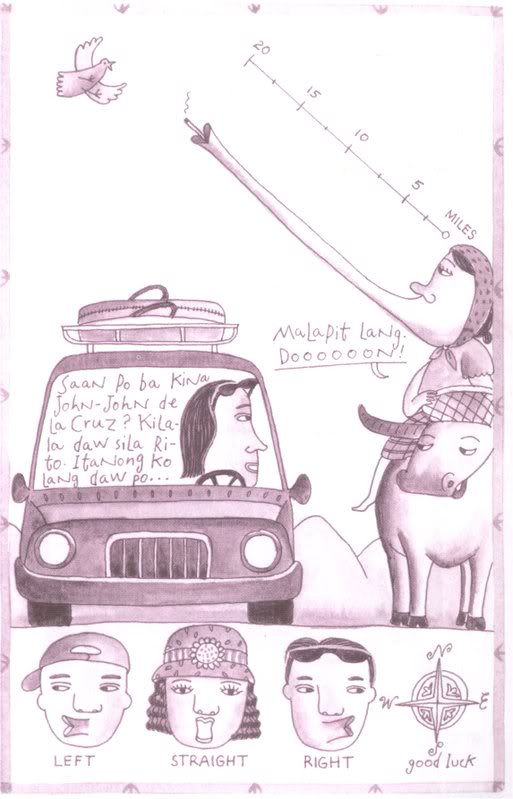
Yes, we do use pursed lips to point to a specific direction, with minimal (if at all) movement of the neck.

But we are actually not the only people who do so. 

According to Ms. Corina Roberts, founder of the nonprofit Redbird, Native American Indians do the same thing -- and for them, "it isn’t just people that you shouldn’t point [your fingers] at, but also trees and animals, homes, graves, regalia and medicine items."  She enumerated several reasons:
Pointing to an object or person is unnecessary when you can describe it with a name or word, and when the person you are conversing with knows the name or description of the subject intimately.  There were few things that were unfamiliar.  You wouldn’t need to point out a stranger; their unfamiliarity would be quite obvious.
Pointing would also have been confusing in communicating, since there was a system of sign language that often bridged the gap between native peoples who spoke different languages.  The sign made to ask someone their name is about as close to pointing as this language comes, and it is done with the palm toward the person making the sign, and the index finger pointing upward as much as toward the person in question.

Pointing is perceived, with somewhat universal agreement among tribal people, to be accusatory.  As one Hupa grandmother told her grand daughter, “finger pointing was an accusation of someone doing something bad and that was a way of telling on that person”. She said “there was always a silent agreement among our people to never tell on one another”.

There is another all-important factor that is often not expressed with regard to pointing, whether it is at a person or an object.  There is energy, or medicine, relating to all living things.  To point at someone could be perceived as affecting them with your energy, or taking theirs.  When you live with a conscious awareness of the physical, spiritual and energetic presence of those around you, pointing takes on additional gravity. 

As one Creek woman from Green Country, Oklahoma put it, “We don’t point with our fingers or hands. I think that it is not just rude, but also because some people use their hands for medicine, and so it creeps people out. It’s rude to make people feel like you might be doing something when you are not. It’s also bad to touch people you aren't close to unless you are shaking hands at certain times. Even then, many people are still uncomfortable about that...no touching and no pointing...may be someone puttin’ their bad on you”.
Now, this explanation is interesting because we do have a historic link with Native Americans: 
With the Spanish colonization of the Philippines, two new groups of people were introduced to the country.  These are the Spaniards and the American Indians....The American Indians that were brought here, according to author Austin Craig, nearly numbered similar to the native population. Most of them are of Nahuatl (Aztec) or Yaqui descent, or are Mexican mestizos themselves. Many of them intermarried with the indigenous population, particularly in Luzon.  (Source: NationMaster.com)
Now, maybe we did acquire the habit from our Native American forebears, and generally for the same uses and reasons given above by Ms. Roberts -- i.e., pointing is too rude, too open, too blatant, too accusatory.  But most of my experiences with Filipinos' lips-pointing suggest, well, other uses not touched on by her explanation. 

Let's talk about men first.  There are numerous uses, but I will only highlight two:

One: What does a typical Filipino guy do to alert his buddies that a chick is coming?  Answer: Purse his lips, point it slightly to the direction of the chick, and let the black of his eyes follow the same direction WITHOUT any neck movement.  Note: For this signal, the size of the dilation of the guy's pupils is directly proportional to the gorgeousness of the chick.

Two: Seeing his friend busy flirting with a new girl, what does a loyal wingman do once he sees that his friend's girlfriend -- known to have Talibanic tendencies when wronged --  is unexpectedly arriving?  The answer is the same: Purse his lips, point it slightly to the direction of the girlfriend, and let the black of his black eyes follow the same direction -- again WITHOUT any discernible neck movement.  Note though that the most important facial feature accompanying this signal is the furrowed brow which should unmistakably warn of a clear and present danger.

But what about for Filipino women?  Well, the sexual inverse of the two uses I outlined above applies as well.  However, my experience also taught me that they use lips-pointing much more often and much more creatively.  They'll use it when gossiping talking about others, each other, or you.  Sometimes, because they're too shy to put wants and needs into words, they'll use the signal if they want something -- "this thing" or "that thing" -- and where they want it -- "here" or "there."

So how do you figure out what exactly they mean?  Well, you have to pay attention to the eyes -- because indeed, the Filipina's eyes are the windows to her soul. 

And let me end with a warning: Misread the signal at your peril -- or your loss, as the case may be. ;-)

Got a question for The Filipino?  Email him now at askthepinoy@gmail.com.
Related Posts Plugin for WordPress, Blogger...