Showing posts with label Language. Show all posts

Feb 23, 2011

Why do Filipinos use "F" and why do they confuse their "fees" and "epps"?

Dear Filipino,

Why is "Filipino" spelled with an "F" when there is not even an "F" in the Pilipino alphabet? And why do many Filipinos pronounce their F's as P's?

Rene Astudillo

Dear Rene,
The Filipino admiring St. Stephen's
Basilica with his daughter.

For several days in the last week, I was with my wife (and the kids as well) in Budapest, Hungary to celebrate our 12th wedding anniversary.  But it was a special trip for my wife and I for two other reasons: The country was the 26th we've visited (we are aiming for 50 before age 50) and the city proved to be a traveler's must-see -- i.e., it has lots of fantastic sights and a history so colorful I wish we had a real historian as a local guide.

But ask my two kids (one is almost 8 and the other is 5 1/2) what stuck to them the most about the trip and you'll likely get a version of this: "Wow! The Hungarian language uses lots of Z's!" 

And it's true -- the letter "Z" is indeed everywhere in Budapest, from the street signs to the ads to the names of places and things (and also, apparently, in lots of Hungarian verbs).  That's because, of the 44 letters in the "greater" Hungarian alphabet (which is really an extension of the Latin language even though it's used to write the Hungarian language which is a member of the Finno-Ugric language family), 4 have the "Z" as an integral part (a glyph) of the particular letter -- i.e., Dz, Dzs, Sz and Zs -- on top of the stand-alone Z.  (In orthography, the Hungarian letters Dz, Sz and Zs are called digraphs while the letter Dzs is called a trigraph. )

The bus lane in Budapest which prompted The Filipino's
son to ponder the question: "If bus is spelled as busz in
Hungarian, how do you spell chess in Hungarian?"
I placed the word greater in quotation marks because the Hungarian alphabet also includes the letters Q, W, X and Y which are only found in words considered foreign to Hungarians.  In other words, there is what's referred to as a "smaller" Hungarian alphabet which contains only 40 letters.

Like the Hungarians, the Japanese has an orthography which uses a comparable, albeit more complex, way of writing their language.  I'm talking here of course of the three Japanese writing systems: Kanji, which is actually composed of traditional Chinese characters which have Japanese translations; the Hiragana which is used to write Japanese words not covered by Kanji; and the Katakana which is used primarily for transcription of foreign language, loan words, as well as technical and scientific terms.

Ooppss!  Somebody forgot the Z!
By now, you're probably thinking: "Arigatō for all these info, but what the 'epp' are you talking about and how is this intro even related to my question?"

Well, allow me to explain further. 

I don't know about you, but when it comes to understanding my Filipino-ness, it has been my experience that I just understand things better when I look for explanation outside the Philippines, and, though difficult sometimes, search for clues and parallels beyond my very Filipino frame of mind.

For instance, the very premise of your question is that the "Pilipino alphabet" does not have "F" in it.  But the premise is only correct if you're approaching it from a perspective which uses pre-Hispanic phonemes as basis.  In other words, we don't have the "F" if you're thinking of the "smaller" Filipino alphabet which had only 20 "letters" -- i.e., the old "Abakada" as created by Lope K. Santos in 1940 which he supposedly patterned after the Baybayin despite the fact that the latter is actually technically a syllabary, not an alphabet, and in any case is written very differently from Latin-based alphabets.

But as a matter of fact, like the Hungarians, we also have had a "greater" alphabet, which at various times had either 28, 29, 31 or 32 letters because we were using the Spanish orthography which had digraphs like the Ch, Ll and Rr and because we were also using all the letters in the English orthography following the take-over of the Americans as our new colonizers.  And actually, we could easily have had more if, like the Hungarians, we considered the vowels which use diacritical marks like the acute, the grave and the circumflex as separate letters.  And it would actually have made sense because we pronounce vowels very, very differently depending on the words used.  For instance, the "o" in guro (Tagalog for "teacher") should be written with the circumflex (as in gurô) because it is pronounced very differently from the "o" in siguro (etymologically Spanish but is now also the Tagalog word for "maybe"). 

In any case, the understandable confusion around our alphabet finally stopped in 1987 when we adopted what is now known as the "Modern Filipino Alphabet."  This alphabet is made up of 28 letters and includes the entire 26-letter set of the Basic Modern Latin alphabet, the Tagalog digraph Ng, and the letter Ñ which was bequeathed to us by the Spaniards.

And speaking of the Spaniards, the word "Filipino" is itself -- it should come as no surprise -- actually Spanish ("efe" is one of the 27 letters in the Spanish alfabeto).  The term, derived from the name given to the country by our Spanish colonizers to honor their king, was originally used to refer to Spaniards born in the Philippines (also called the insulares) and to distinguish them from Spaniards born in Europe (the peninsulares).  However, according to historian Ambeth Ocampo, our national hero José Rizal appropriated it for all of us and was the first to call the indigenous inhabitants of the islands Filipinos.  Thus, because of Rizal, the term Filipino began to be widely used to refer to the natives by the end of the 19th century.

But if the country is called the Philippines, why are we not called Philippinos instead?  According to Daniel Engber of Slate:
The Philippines have only been called the Philippines (with a "Ph") since the United States bought the country from Spain around the turn of the 20th century, after the Spanish-American War. Under Spanish colonial rule -- which extended back to the 16th century -- the country had been called "Las Islas Filipinas," after King Felipe II. For Americans, Felipe was Phillip, so Las Filipinas became the Philippines. While the name of the country changed, the name of the nationality did not. Those who lived in the renamed Philippines were still called Filipinos.
But where did the word "Pilipino" come from?  Engber further explains that:
The term "Pilipino" derives from the convoluted story of how the Philippines got its national language. There was no official, native language under Spanish and American control. Those living on the islands could be divided into as many as 120 different groups, each with its own way of talking [175 actually, according to Ethnologue]. The desire to create a mother tongue increased when the United States pulled out of the country and the Philippines became a commonwealth in the 1930s. A national institute was given the task of making one of the native languages official.
In 1936, this institute, the Institute of National Language, selected Tagalog as the basis of the national language but incorporated elements of the country's other native languages.  The Abakada alphabet created by Santos in 1940 was also officially adopted to "indigenize" the writing system.  However, because of the almost 400 years of combined Spanish and American influence, the newly adopted alphabet was seen as inadequate and impractical because many consonants used regularly by locals were missing in the Abakada. 

Moreover, because speakers of the other Philippine languages were upset and felt marginalized, the government saw it fit to rename the national language into "Pilipino" instead in 1959.  But why "Pilipino" and not "Filipino"?  As already alluded to above and further expounded on by Engber:
The developers of the mother tongue looked back to the alphabet that was used before the Spaniards took over (and in the early years of Spanish rule). The native script, called "Baybayin," had fewer than two dozen letters and didn't include the sound for "F." Though the letter "F" had been incorporated into the language during the centuries of Spanish influence, the country's post-colonial leadership chose to return to the original alphabet. [NOTE: Here, I think Engber also made the mistake of thinking Baybayin is an alphabet rather than a syllabary.]  Foreign words that used "non-native" sounds were respelled to fit the Baybayin-based alphabet. C's became K's, X's turned into SK's, and the letter F became a P. [NOTE: This is akin to the Japanese way of transcribing foreign words using Katakana.]  Filipinos who spoke Tagalog became Pilipinos who spoke Pilipino.

The debate over the national language continued for decades. A constitution written in the early 1970s (drawn up as Ferdinand Marcos instituted an eight-year stretch of martial law) promised to create a new national language called "Filipino." The next constitution, from 1987, made the change official, designating Filipino -- which uses a larger alphabet and incorporates foreign sounds -- as the national language. With the letter "F" restored, presumably those who speak the national language are now, once again, Filipinos.
Now, onto your other question: Why do many Filipinos confuse their F's and P's? 

Indeed, many of us do and I know for a fact that this "pronunciation confusion" has also been a source of jokes, to say the least.  Worse, it has also been a source of prejudice and disdainful elitism.  I've personally seen it many times that Filipinos with a more Americanized way of speaking English go way beyond teasing and look down with an unwarranted sense of superiority upon those who speak the language with a "Filipino accent."

And for many of us who grew up in the provinces, the teasing and the condescension cause, at the very least, a lot of hurt "peelings." ;-)  In fact, for the typical provinciano, speaking English with a strong Filipino accent can be costly because it can mean less career opportunities and even alienation in an environment (say, a top school or a business organization) which prizes fluency in spoken English. 

And when you think about it, it's really quite unfair considering, for provincianos like myself, English is really our third language. After all, we have our provincial language as our first and native tongue, and then we are forced to learn Tagalog and English too!  Now, compare us to the elitist folks who come mostly from Manila and who only needed to master English as a foreign language, and I say, if anything, we're supposed to be the ones "peeling" superior here, right?

But to go back to the crux of the topic, what's the real reason behind this Philippine phonological confusion involving the pronunciation of "F"? Well, it's simple really: Because, quite literally, our native Filipino tongues are still generally Malayo-Polynesian even if we've already adopted a more expansive alphabet as a country, even if we've undergone almost 400 years of colonization.  So, if you're a typical provinciano who, as I've said earlier, has had to learn not only the local language (most likely Malayo-Polynesian) but also Tagalog (definitely Malayo-Polynesian), your tongue -- in fact, your entire vocal tract -- is just not naturally hard-wired for words with the "F" phoneme (or for that matter, the "V" phoneme).  So unless you're exposed to English regularly (i.e., you're from a rich Filipino family or you were educated in top schools), or you are, say, an Ibaloi from Northern Luzon whose indigenous language contains the "F" phoneme, it's really not that easy to pick up the phonetic ability to pronounce "F" properly.

The vocal tract and places of articulation.
(Source: Wikipedia.)
And in fairness, pronouncing foreign words is really not easy for almost everyone, especially if the sound that needs to be produced is non-existent or has no comparables in one's native language.  That's why for the Anglicized ear, the French can't seem to pronounce "H" quite properly and the Germans and the Dutch appear to mistake "V" for "W" quite regularly when these people speak English.  That's also why the Brits can't quite produce the rolling "R" perfected by the Spaniards.  That's why learning to read Scandinavian languages is easier than learning to speak them because they use a lot of glottal stops and what-not.  That's why the Arabs, whose words are pronounced more throatily, will find learning a language like Vietnamese or Chinese, which are very nasal, very, very difficult.  That's why the Japanese, who don't really use "L" and "V" in their language, will pronounce "I love you" as "I rob you"!

Personally, I always have fun making my Western friends try to pronounce the word "ngayon" (Tagalog for "now") because it uses the digraph "ng" which is a velar nasal, a type of consonantal phoneme which most Westerners, try as they might, just seem unable to make.  Unfazed, they would try pronouncing the word many times and I would usually end up laughing even though I try not to.  Fortunately, my friends know I'm just having fun.  And to write it in Hungarian, I think they know I'm really juszt amuszed by their szilly attemptsz which yield nothing but erroneousz szoundsz.

Got a question for The Filipino?  Email him now at askthepinoy@gmail.com.

Feb 3, 2011

Why are Filipino nicknames repetitive and do Filipinos name private parts in a similar manner?

Dear Filipino,

Why do Pinoys love giving nicknames to their kids that repeat the same name/syllable (e.g., Dodo, Toto, Leklek, etc.).  Is it true that most of their private parts are named in a similar manner?  That is, in the examples given, you just change the vowels? LOL!

Boy B.

Dear Boy,

It’s true: Filipinos do love to give nicknames with syllables that repeat. I mean, who can deny it?  The sitting President himself sports one: Noynoy.  And the Vice President? Jojo.  And the Cabinet's Executive Secretary?  Also Jojo.

I personally grew up with neighborhood playmates, classmates and friends with nicknames like Penpen, Dandan, Denden, Dondon, Dindin, Lotlot, Lala, Nene, Bebe, Jonjon, Junjun, Tintin, Yanyan, Tingting, Toto, Katkat, Macmac, Maimai, Nognog, Ningning, Chichi, Baba, Bongbong, Bangbang, Bingbing, Bambam, Bimbim, Bumbum.

Then, there are those with Western-sounding double-initialed names: AA, BB, CC, DD, GG, JJ, MM, RR,TT.
 
(Source: SaintBarry.wordpress.com)
A little imperfectly repetitive, I know of Dodot, Dodong, Kakay, Kokoy, Dodoy, Totoy, Boboy, Nonoy, Popoy, Momoy.

Believe me, I can go on and on and on.

But what accounts for this, er, national tic? Are we suffering from some sort of collective palilalia, the pathological repetition or echoing of one's own spoken words?

The answer, actually, is found in linguistics.  And here below is my theory.

You see, almost all languages in the Philippines belong to the Malayo-Polynesian family of languages, which is itself a member of the Austronesian clan. As such, our languages are agglutinative – i.e., we extensively glue words together to form new words.

We do it by joining what are called morphemes in linguistics.  Think of morpheme like you think of an atom: It is the smallest, irreducible component of a word that has its own semantic meaning, and a combination of several of these make a word. Wikipedia has this English example: The word "unbreakable" has three morphemes: "un-", a bound morpheme because it cannot stand alone; "break", a free morpheme because it can; and "-able", another bound morpheme. The morphemes "un-" and "-able" are called affixes: the former is a prefix, the latter is a suffix.

Generally, new words are said to be created using three methods: by affixation (i.e., by attaching affixes onto a root word); by composition (i.e., by forming a compound word); or by reduplication (i.e., the repetition of words or portions of words).

Occasionally referred to as cloning or doubling and found in a wide range of languages, reduplication may be full or partial; if the latter, it may be initial (i.e., prefixal), final (i.e., suffixal), or internal (i.e., infixal). It has many uses, but it is used primarily to indicate a different tense of the root verb; pluralize a noun; adjectivize a noun; adverbialize an adjective, noun or verb; accentuate or intensify an emotion; adopt a more expressive tone; speak figuratively; or express conceptual similarity.

Going back to Filipino nicknames, many of them are actually terms of endearment commonly used by parents in addressing their children. Bicolanos, for instance, use the generic loving terms “nonoy” (if male) and “nene” (if female) to address their babies, toddlers and young kids. But for many of these children, these common nouns stick and as their nicknames, become proper nouns, because to the dismay of some, they never outgrow them.

(Source: IlovehateAmerica.com)
Now, many Philippine terms for private parts indeed use reduplication.  But what I really find interesting is that our languages really don’t seem to have more “clinical-sounding” terms for them. Instead, we have terms that regular people completely avoid mentioning in polite conversation because they sound lewd, rude or linguistically belonging to someone uncouth, uneducated, lascivious, given to prurient thoughts, or otherwise, well, horny. 

And when we do find ourselves absolutely needing to, we use English, or if it really has to be in a Philippine language, we use all sorts of euphemisms or less threatening language – i.e., we “speak figuratively” and/or “express conceptual similarity” – hence, our use of linguistic reduplication.  That's why the scrotum becomes bola-bola instead of the rougher-sounding bayag; the penis is infantilized and gets called pitotoy instead of the more potent uten; the breasts become baby-ish, life-nurturing dede instead of the babe-ish, lust-conjuring dyoga; and vagina is turned less veteran-ish and gets called pekpek instead of the more experienced-sounding puki. (Interestingly enough, the Tagalog version of "The Vagina Monologues" was called "Usaping Puki".)

Personally, though, I do not know of any parent who would or did name his/her child after private parts (I know a couple of people nicknamed Dong but their well-meaning parents were surely after the onomatopoeic ring to it!).  But to get some inputs, I actually forwarded your question to my friend, EZ, who is also a lawyer (so I have no reason to doubt his truthfulness!) and who shared with me a funny story which he claims actually happened during a Little Miss Philippines contest on Eat Bulaga! in the late 1980s.

According to him, there was a contestant nicknamed Kengkeng. When one of the hosts, Vic Sotto, asked her why she was nicknamed Kengkeng, her answer on live TV was: "Kasi po, noong ipinanganak ako, ang taba-taba daw po ng aking pukengkeng!" 

[SHORT BREAK BECAUSE BLOGGER IS STILL R.O.F.L.!]

Okay, here’s the deal: If you didn’t understand the joke because it’s in Tagalog, I’m so sorry but this is one occasion which I will not translate in English.  So this is a good reason for you to ask your Tagalog-speaking friend for a translation, or get to know one who is.  But make sure you show this blogpost first because if you ask it verbally without properly contextualizing the line, I can’t guarantee that you won’t get slapped in the face!

Got a question for The Filipino?  Email him now at askthepinoy@gmail.com.

Dec 27, 2010

Why is "Milk!" a Filipino expletive?

Dear Filipino,

How did the Spanish word "leche" become a Filipino cuss word?

Tony S.
Los Angeles, CA


Dear Tony,

You have to understand that when the noble Spaniards decided to colonize and Christianize us, they didn't really bother educating us about the finer distinctions between the eschatological and the scatological.

If you're confused as to which is which because they are almost homophonic and homonymous, here's a short guide: The former deals with the Second Coming, the resurrection of the dead, the Last Judgment, heaven and hell; the latter, on the other hand, is about giving someone hell.  One is obsessed with fatal matters, the other with fecal matters.

This is an important starting point because it appears the Spaniards have mastered both.  That's why they are credited with having brought many to the Christian fold and having formulated one of the world's most devastating invectives ever hurled, as compiled by Cracked.com.  And the Spanish insult in the Cracked.com compilation provides the clue to the riddle behind the Filipino expletive.

So, why "milk"?

(Source: Jane Heller.) 
Some people who have some familiarity in this area think that milk, when used as a profanity in Spanish, refers to male sperm, presumably because of the similarity in color between the two liquidy substances, and that somehow because of this reference, the phrase in and of itself becomes offensive. 

I urge you not to buy into that line of thinking.

The etymological theory to which I subscribe is the one which is reasonably related to the eschatological-scatological conundrum I mentioned above, and it is this: that "leche" is derived from "Me cago en la leche," which literally translates to "I defecate in the milk."

Now, this phrase is meant to be not just irreverent and profane but outrightly blasphemous of the Catholic rite of Communion.  Why?  Because leche is used interchangeably with the word hostia ("host") -- as in "Me cago en la hostia," among many other colorful usages, especially in Spain and Puerto Rico. 

For Catholics, the "host," of course, is the religious symbolism for the "Body of Christ," or the transubstantiated Host of the Eucharist.  So how more offensive can you get to Catholics than by uttering that deplorably hideous phrase?

Whether the Filipinos who first used leche as an obscenity knew of its etymology, nobody really knows, I think.  We do know that the Spaniards did not really want Filipinos to learn Spanish, but the natives caught on to their overlords' language anyway, albeit incompletely and inaccurately. 

In this case, they probably got the "milk" part and that part only -- but appropriated it nonetheless for their own use.  (It's also entirely possible, of course, that some just purposefully shortened the phrase to make it more emphatic and more punchy while at the same time avoiding the use of the potty word cago.) 

Hence, many Filipinos now commonly say "Leche!" (pronounced and spelled sometimes as "Letse!") when they swear.  And when they want to direct their ire to a specific person or persons, they say, quite nonsensically, "Leche ka!" ("You're milk!") or "Mga leche kayo lahat!" ("You are all milk!"), without really comprehending what they are in fact saying and without knowing they may be "attacking" their very own religion.

They do know one thing:  That when they're yelling these intended obscenities, they want to give the recipients some measure of hell.  As to the recipients, they can only wish, quite understandably, that the Second Coming is indeed nigh.

Got a question for The Filipino?  Email him now at askthepinoy@gmail.com.

Dec 24, 2010

How many ways can you say "Merry Christmas" using Filipino languages?

Dear Filipino,

How many languages are spoken in the Philippines. I understand not everyone speaks Tagalog?

Colleen Butler

Dear Colleen,

People who have tried to answer your question in the past have come up with wildly different answers.  The reason is simple: As always, it boils down to the definition of terms; even better put, it boils down to the difference between what is considered a "language" and what is considered a "dialect." 

The thing is, there are no universally accepted criteria for distinguishing them, and the difference is often a matter of degree rather than of kind.  According to Dr. Tucker Childs, professor of Linguistics at Portland State University, it's because:
[T]hey're not objective, scientific terms.  People use the words "dialect" and "language" to mean different things. "Language" can often refer to your own linguistic variety and "dialect" to the variety spoken by someone else, usually someone thought of as inferior. Or "language" can mean the generally accepted "standard" or radio-talk language of a country, while dialects are homely versions of it that vary from region to region and may not be pronounced the way the so-called "language" is. Language varieties are called "dialects" rather than "languages" because they're not written, or because speakers of that variety don't run the country, or because their language lacks prestige. In short, the distinction is subjective...

One of the tests people use to differentiate "language" from "dialect" is mutual intelligibility. You can say that people speak the same language -- or a dialect of the same language -- if they understand each other. If they don't understand one another, they must be speaking different languages. That seems like a good rule. So why, in a case like the Cologne and Bavarian dialects, which aren't mutually intelligible, don't the Germans call them separate languages? Or why are Swedish and Norwegian separate languages, when Swedes and Norwegians have no trouble understanding one another? It's really pretty confusing.
Further, according to John R. Rickford, professor of Linguistics at Stanford University:

The most significant variations or differences within languages occur at the level of the lexicon (vocabulary), phonology (pronunciation), grammar (morphology and syntax), and usage.  Moreover, they are not just qualitative, in the sense that dialect A uses one feature and dialect B another, but they may also be quantitative, in the sense that dialect A uses one feature more often than dialect B does....Finally, variation may be regional, social or stylistic in its origins, and the methods that linguists have used to study each type differ slightly.
Thus, in order to answer your question, I turned to Ethnologue: Languages of the World.  Ethnologue is a web and print publication of SIL International (SIL stands for Summer Institute of Linguistics), which trains Christian missionaries to be linguists, sending them to learn local languages, design alphabets for unwritten languages and introduce literacy -- primarily to provide the speakers with Bibles in their native language.  Thus, Ethnologue's history has drawn some criticism from secular linguists, but it has grown so comprehensive since its start in 1951 that it is now THE leading authority on languages and an indispensable resource for academics and governments.

According to Ethnologue, Philippines has a total of 175 languages,171 of which are living languages and 4  are considered extinct, i.e., no known speakers.  Yours truly fluently speak and write only 2 of these 175 languages, but can probably survive in a few more.  Note that Tagalog, while officially considered the national language, is only spoken as a native language by 28.15% of the total Philippine population (based on the 2000 census).

Today being the eve of Christmas, I decided to do just a little bit of scouring on the Web for Filipino translations of the season's greeting: "Merry Christmas and Happy New Year!" 

I came up with only the ones below, but the variety floored me nonetheless.  I hope other Filipinos who get to read this post can send their version to me so I can keep updating the compilation for the next years to come.

Bicolano - Maugmang Kapaskuhan asin Masaganang Ba-gong Taon
Cebuano - Malipayong Pasko ug Bulahang Bag-ong Tuig
Chavacano - Felices Pascua y Prospero Anyo
Dibabawon - Marayaw na Pasko aw Bag-ong Tuig
Hiligaynon - Malipayon nga Pascua kag Mahamungaya-on nga Bag-ong Tuig
Ilocano - Naimbag a Pascua ken Naragsac nga Baro nga Tawen
Inakeanon - Malipayon nga Paskwa ag Mahigugmaon nga Bag-ong Dag-on
Inonhan - Malipayon nga Paskwa kag Masadya nga Bag-ong Tuig
Manobo - Mepiya Pagasaulog aw maontong kaling Omay
Mansaka - Madyaw na Pasko aw malipayong Bag-ong Tuig
Pampangan - Malugud Pascu at saca Masayang Bayung Banua
Pangasinan - Maabig ya pasko Maliket ya Balon Taon
Sambal - Maligayang Pasko at Masayang Ba-yon Taon
Tagalog - Maligayang Pasko at Manigong Bagong Taon
Waray-Waray - Maupay nga Pasko ngan Mainuswagon nga Bag-o nga Tuig
Got a question for The Filipino?  Email him now at askthepinoy@gmail.com.

Dec 13, 2010

Why do Filipinos make sitsit? Part 3 of 3

Dear Filipino,

First question: don't you notice that when you are in the men's restroom with fellow Pinoys, we usually spit before making weewee? Hahaha!  Or how we use our lips for pointing things and making sitsit (psst psst) to others, esp. kids?  More serious qs to come -- hope Mark Zuckerberg buys this great site for $ 1 billion!

Sweaty in Singapore


[Part 1 -- "Spitting before pissing" has been answered here.  Part 2 -- "Pointing by lips" is here.  This is Part 3 -- "Making sitsit."]

Dear Sweaty,

Sorry for the long delay with my third installment.  Over the last few days, I was very busy and traveling -- from the Old to the New World -- and had kids in tow to babysit to boot.  Right now, I'm in bed with my laptop, awake in the wee hours of the morning because of jet lag, and so have some time to devote to the task of trying to decipher mind-blowing riddles of cosmic importance -- like your question, for instance.

But it's a good thing you parenthetically qualified your question because sitsit actually has two meanings/usages. 

One usage of sitsit in Tagalog is to engage in tsismis or gossip.  Now, many Filipinos do engage in a lot of tsismis, but this is not your question so I will not talk about it.  Besides, it's also really a minefield of a topic I'd rather avoid for now.

The other usage, the one enclosed in your parenthesis, is the onomatopoeic Filipino word for calling or attracting someone's attention in a surreptitous, inconspicuous or unobstrusive way.  

It is onomatopoeic because the word is derived from the sound associated with the act of calling itself.  But since Tagalog is a language based originally on a syllabary system of writing which does not really allow for syllables to not have a vowel, we drop the "p," add the "i" and use "sit" twice (another interesting habit: our act of repeating words), even though we really produce the sound "psst," which is a fairly common "interjection" -- i.e., "a sudden short utterance; an ejaculation."

But why do we sitsit?

For this, I think we need to go back to the definition above to divine an answer.  Notice the adjectives "surreptitous," "inconspicuous," and "unobtrusive" preceding the word "way"?

My guess is that its usage became popular among Filipinos for similar reasons that made pointing with lips popular.  And maybe because we've been colonized by foreigners for hundreds of years, we needed to adopt or invent other ways to communicate for situations that require more finesse, subtlety and/or secretiveness. 

Thus, we make sitsit to genericize a call out (akin to a whistle really when, say, a sexy lady is passing) or to call the attention of another when it would be advantageous not to use his/her name.

And because we are not an in-your-face culture, calling by sitsit is also the closest you can get to a whispery shout, if such an oxymoron is even possible.  (Thus, quite understandably, in some cases, it can be quite annoying or downright insulting.) 

Now, the use of sitsit with kids is generally the same as its use with adults, except of course it also functions as a stronger form of "shhhh" to hush them into silence.  That "t" in the "psst" impressively gives it the force of a command and really functions as an authoritative exclamatory ending necessary to compel obedience. 

Take it from someone who has to babysit lovable but overeager and quarreling kids from time to time.

Got a question for The Filipino?  Email him now at askthepinoy@gmail.com.

Dec 9, 2010

Why do Filipinos point with their lips? (Part 2 of 3)

Dear Filipino,
 
(Source: Western-Asian.com)
First question: don't you notice that when you are in the men's restroom with fellow Pinoys, we usually spit before making weewee? Hahaha!  Or how we use our lips for pointing things and making sitsit (psst psst) to others, esp. kids?  More serious qs to come -- hope Mark Zuckerberg buys this great site for $ 1 billion!

Sweaty in Singapore

[Part 1 -- "Spitting before pissing" has been answered here.  This is Part 2 -- "Pointing by lips."  Part 3 -- "Making sitsit" -- to follow soon.]

Dear Sweaty,

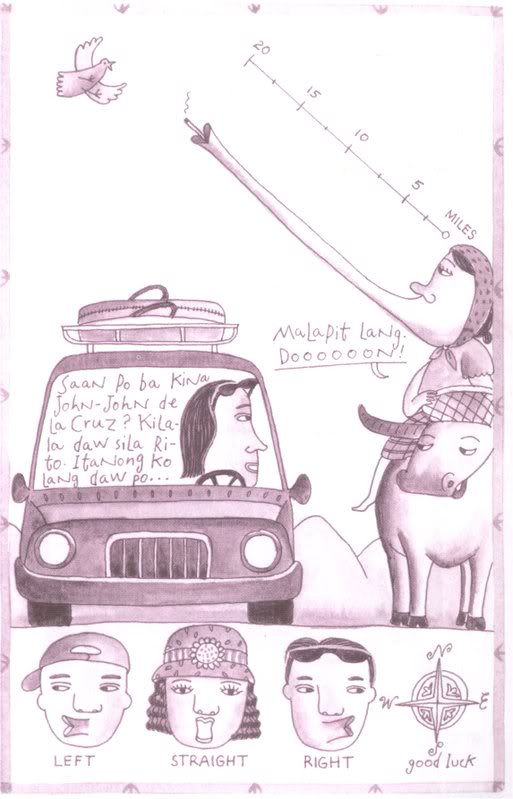
Yes, we do use pursed lips to point to a specific direction, with minimal (if at all) movement of the neck.

But we are actually not the only people who do so. 

According to Ms. Corina Roberts, founder of the nonprofit Redbird, Native American Indians do the same thing -- and for them, "it isn’t just people that you shouldn’t point [your fingers] at, but also trees and animals, homes, graves, regalia and medicine items."  She enumerated several reasons:
Pointing to an object or person is unnecessary when you can describe it with a name or word, and when the person you are conversing with knows the name or description of the subject intimately.  There were few things that were unfamiliar.  You wouldn’t need to point out a stranger; their unfamiliarity would be quite obvious.
Pointing would also have been confusing in communicating, since there was a system of sign language that often bridged the gap between native peoples who spoke different languages.  The sign made to ask someone their name is about as close to pointing as this language comes, and it is done with the palm toward the person making the sign, and the index finger pointing upward as much as toward the person in question.

Pointing is perceived, with somewhat universal agreement among tribal people, to be accusatory.  As one Hupa grandmother told her grand daughter, “finger pointing was an accusation of someone doing something bad and that was a way of telling on that person”. She said “there was always a silent agreement among our people to never tell on one another”.

There is another all-important factor that is often not expressed with regard to pointing, whether it is at a person or an object.  There is energy, or medicine, relating to all living things.  To point at someone could be perceived as affecting them with your energy, or taking theirs.  When you live with a conscious awareness of the physical, spiritual and energetic presence of those around you, pointing takes on additional gravity. 

As one Creek woman from Green Country, Oklahoma put it, “We don’t point with our fingers or hands. I think that it is not just rude, but also because some people use their hands for medicine, and so it creeps people out. It’s rude to make people feel like you might be doing something when you are not. It’s also bad to touch people you aren't close to unless you are shaking hands at certain times. Even then, many people are still uncomfortable about that...no touching and no pointing...may be someone puttin’ their bad on you”.
Now, this explanation is interesting because we do have a historic link with Native Americans: 
With the Spanish colonization of the Philippines, two new groups of people were introduced to the country.  These are the Spaniards and the American Indians....The American Indians that were brought here, according to author Austin Craig, nearly numbered similar to the native population. Most of them are of Nahuatl (Aztec) or Yaqui descent, or are Mexican mestizos themselves. Many of them intermarried with the indigenous population, particularly in Luzon.  (Source: NationMaster.com)
Now, maybe we did acquire the habit from our Native American forebears, and generally for the same uses and reasons given above by Ms. Roberts -- i.e., pointing is too rude, too open, too blatant, too accusatory.  But most of my experiences with Filipinos' lips-pointing suggest, well, other uses not touched on by her explanation. 

Let's talk about men first.  There are numerous uses, but I will only highlight two:

One: What does a typical Filipino guy do to alert his buddies that a chick is coming?  Answer: Purse his lips, point it slightly to the direction of the chick, and let the black of his eyes follow the same direction WITHOUT any neck movement.  Note: For this signal, the size of the dilation of the guy's pupils is directly proportional to the gorgeousness of the chick.

Two: Seeing his friend busy flirting with a new girl, what does a loyal wingman do once he sees that his friend's girlfriend -- known to have Talibanic tendencies when wronged --  is unexpectedly arriving?  The answer is the same: Purse his lips, point it slightly to the direction of the girlfriend, and let the black of his black eyes follow the same direction -- again WITHOUT any discernible neck movement.  Note though that the most important facial feature accompanying this signal is the furrowed brow which should unmistakably warn of a clear and present danger.

But what about for Filipino women?  Well, the sexual inverse of the two uses I outlined above applies as well.  However, my experience also taught me that they use lips-pointing much more often and much more creatively.  They'll use it when gossiping talking about others, each other, or you.  Sometimes, because they're too shy to put wants and needs into words, they'll use the signal if they want something -- "this thing" or "that thing" -- and where they want it -- "here" or "there."

So how do you figure out what exactly they mean?  Well, you have to pay attention to the eyes -- because indeed, the Filipina's eyes are the windows to her soul. 

And let me end with a warning: Misread the signal at your peril -- or your loss, as the case may be. ;-)

Got a question for The Filipino?  Email him now at askthepinoy@gmail.com.
Nov 19, 2010

The Mexican asks: How much Spanish remains in Filipino languages?

Dear Filipino,

How much Spanish remains in Tagalog or any of the other Filipino languages?  Whenever I'm enjoying my pansit bihon with lechon and the turo-turo joint is broadcasting some Pinoy show on the television, I can't concentrate because the sprinkling of Spanish makes me feel like I should know what everyone is saying!

The Mexican

The Mexican

Dear Mexican Dear Idol,

First of all, thank you very much for your email and question!  The Filipino is honored -- no, make it extremely honored and grateful! -- that you've written to encourage him to keep up this blog, which was inspired in the first place by your "Ask a Mexican!" column!

[NOTE: This and the next few paragraphs, which are enclosed by the brackets, are not for you, Idol, but for the uninitiated.

A Filipino turo-turo joint, or a carinderia, is a local eatery which serves inexpensive home-cooked meals and is typically characterized by a very informal ambience: i.e., no reservations required, no uniformed waiters at your beck and call, no fancy fixtures, et cetera.  The root word, turo, is a Tagalog word which means "to point," so patrons of a turo-turo joint usually just point from an array of heated but earlier-prepared viands to order their desired meals (although generally they are also able to order a la carte meals at higher price points). 

Pancit bihon is a popular Filipino noodle dish and lechon is a pork dish.  See the below photos for reference:
Pancit Bihon (from wokwithray.com)

Lechon Kawali (from wokwithray.com)
Just looking at the pictures make me salivate, but enough with this aside and on to The Mexican's my idol's question. ;-) ]

The Pinoy television show you were watching was probably in Tagalog, which is the language of the people from the provinces in and around Metro Manila.  It was made the national language in 1937 and renamed Pilipino in 1939. 

There are several good reasons why, whenever you're eating at the turo-turo joint, you feel you should be able to fully understand (but maybe don't) what the Filipinos on TV are talking about.  They are as follows:
  • There are an estimated 4,000 Spanish words in Tagalog, or about 20-30% of Tagalog words while Visayan and other Philippine languages borrowed about 6,000 Spanish words.  But then dig this: Chavacano, which is spoken in Zamboanga, is actually the only Spanish-based creole language in Asia. (So I'm not entirely sure here, but I'm guessing you can probably survive in Zamboanga speaking only Spanish!)
  • With slight changes in spelling and pronunciation, Pilipino incorporated the Spanish terms for counting (uno, dos, tres...), telling time (a la una y media?), the calendar (Enero, Pebrero, Marso...), days of the week (Lunes, Martes, Miyerkoles...), among others.  
  • Spanish has developed "false friends" in Tagalog and in the other Philippine languages.  These are the related words which started out from the same starting point but -- probably because of local usage/application, loss of nuance, or outright misuse -- have developed different meanings with the passage of time (e.g., kontrabida, which is from contra vida, meaning "against life," is now Tagalog for villain).
  • Of course, there are also a lot of "false cognates" -- similar words in Spanish and Tagalog that appear to have a common origin but actually do not (e.g., ama is Tagalog for father but Spanish for housewife).  (I think another good example is the word recently used by Brandon Rios to describe Pacquiao: puto, which is a popular steamed rice cake in the Philippines, but is not exactly a term of endearment in Spanish.)
  • Then, there are the Tagalog words which the Spaniards incorporated into their own language, too (e.g., dalaga, palay, bolo, etc.)
  • And here's the most interesting as far as you and I are concerned: Because the Philippines was directly under the Viceroyalty of New Spain, which was created to administer Spain's far-flung colonies including those in the Spanish East Indies and which was headquartered in Mexico from 1565 to 1821 (until Mexican independence), there was an active Manila-Acapulco galleon trade which allowed many native Mexican words, such as those from the Nahuatl, to creep into Philippine languages (e.g., sayote from chayotl, kamote from camotl, etc.).
Despite the departure of the Spaniards in 1898 from the Philippine archipelago, Spanish remained one of the official languages in the Philippines until 1973.  And in fact, it was still a required subject in colleges across the country until 1987.  Unfortunately, however, except for a few thousand words which became part of the daily Philippine lexicon, The Filipino did not really learn it enough to be able to really converse in the language.

Thanks again for your question, Idol!  Mabuhay ka! ;-)

Got a question for The Filipino?  Email him now at askthepinoy@gmail.com. 
Related Posts Plugin for WordPress, Blogger...