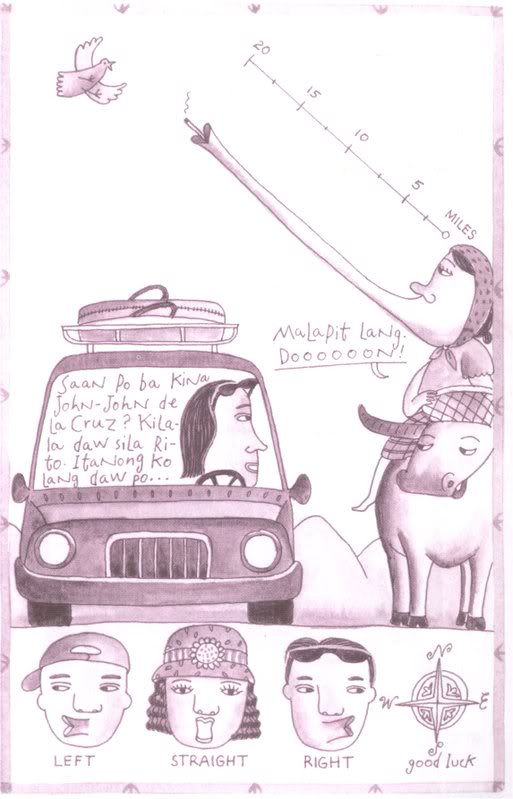
Showing posts with label Customs and Traditions. Show all posts

Mar 24, 2011

Does the Philippines have a future in a technology-driven world and will Filipinos survive in it?

Dear Filipino,

As someone who has worked in Silicon Valley and who researches on and lectures about IT issues, I sometimes wonder what the future holds for the Philippines. It seems like we are only supplying resources (e.g., IT skilled labor) but not really in the forefront and "making things happen," so to speak.

So my question is: Do you think Filipinos will survive in an increasingly high-tech and competitive world?

Nagmamahal,
The Filipina

P.S. By the way, I like love your new logo, too. But how come MuQ is in the logo while I’m not? Sob-sob-sob. :-(

To My Funny Brown Pinay,

First, I’m glad you like the new logo/banner.

Secondly, I’m really sorry that you’re not in the picture, but don’t you think it would look kinda silly if I were riding you instead of MuQ?

Thirdly, I feel bad not answering a lot of pending questions from readers, but I’m really super glad that you asked your question because it's of the kind I really want to write about.  Because if there’s one thing I am absolutely sure, it’s that Filipinos WILL survive. In fact, not only will Filipinos survive, we are on track to conquer the world!  Hah!

Yup, you heard that right! But don’t take my word for it – take instead the word of the former Secretary of Finance, Roberto de Ocampo, who, thanks to a reader who alerted me about it, has recently written about how Filipinos are really “The Chosen People.”
Consider that, according to some researchers, “in order for a culture to maintain itself for more than 25 years, there must be a fertility rate of 2.11 children per family. With anything less, the culture will decline. Historically, no culture has ever reversed a 1.9 fertility rate.”

The 2011 fertility rate estimate for Spain is 1.47, Italy 1.39, UK 1.91, France 1.96 and Germany 1.41, to name a select few. The average fertility rate of all Western Europe is about 1.5. In short, these nations are either on are perilously close to what population experts call an irreversible demographic decline. To put it more starkly, for example, by 2020 (or just nine years from now) more than half of all births in a country like, say, the Netherlands (1.66 fertility rate) will be of non-European Dutch origin. Furthermore, with the birth rate dropping below replacement, the population of such countries ages and the problems facing an aging population are numerous and startling enough to deserve a separate treatise.

Western Europe is not the only one experiencing this phenomenon. The US fertility rate is, at 2.0, just below replacement and Japan is at a worrisome level of 1.2. For Japan, this means a population decline of about 60 million in the next 30 years and an aging population that will have one out of every five Japanese at least 70 years old by 2020.

However, with the exception of Japan, the overall populations of the above-mentioned countries are not declining. The overwhelming reason for that is immigration (to which Japan is by comparison with others, still somewhat resistant). Guess who comprise one of the larger immigrant populations. Yes, dear—Filipinos!
De Ocampo concludes:
Now we have begun to creep into the world’s bloodlines. The 2010 World Series winning pitcher Tim Lincecum, 2011 best supporting actress Oscar nominee Hailee Steinfeld, head coach Erik Spoelstra of the Miami Heat, and R&B star Bruno Mars are all Fil-Ams. It may only be a matter of time before nearly every race on earth has some Filipino blood.
In other words, if you think all these advanced countries are going to go high-tech, Filipinos will at least be tagging along for the ride!

But actually, the truth is, if we play our cards right, we’re not just going to tag along – we can make things happen too, and to a certain extent, we have. In fact, we are really in the position to design our own “ride” – literally!

Now, what do I mean by that?

Well, what I mean is that we have the right ingredients already in place. We have, as you mentioned, the skilled laborers; we have creativity; and, believe it or not, we have years of experience in the transportation field too.

Let’s talk about these ingredients one by one.

First, the skilled laborers.

Many people think of the Philippines as this low-tech country exporting nothing but tropical fruits and basic natural commodities. But in fact, electronics exports accounted for a whopping 61% of the country’s merchandise exports in 2010 which totaled $31 billion. Of that figure, semiconductors comprised 71%!

And Filipinos are not just at the bottom of the high-tech totem pole either, for Silicon Valley has several Filipinos who have achieved substantial success in the field. Dado Banatao, of course, is just one of the more well-known figures, having co-founded Mostron, Chips & Technologies (acquired later by Intel), and S3 Graphics.

All these means, of course, that we have the knowledge capital.  And I strongly believe we also have the creative capital, which, as mentioned earlier, is the second ingredient. 

Kenneth Cobonpue's Phoenix
(Source: TopGear Blog)
In fact, just a few days ago, I read the Inquirer article about Kenneth Cobonpue, a well-known Filipino furniture designer. Apparently, he just outdid himself and designed “Phoenix” – a concept car made out of bamboo, rattan, steel and carbon fiber -- which has drawn raves in a Milan exhibit entitled “Imagination and Innovation.” I saw the picture and it looks awesome – indeed, “a bird posed to take flight.”

What I didn’t like about the Inquirer article is the lead sentence which says in part that “Cobonpue has designed what must be the first and only bamboo and rattan car in the world.”

Why?

Because it’s not true! And this brings me to the last ingredient I earlier mentioned: years of experience.

Actually, the honor of “first and only” bamboo ride rightly belongs to the – note the following adjective closely – out-of-school youth and the former mayor of the remote municipality of Tabontabon, Leyte who actually manufactured public taxis made out of bamboo!
Want a ride aboard the bamboo taxi of Tabontabon, Leyte?

And if you think it’s just superficially bamboo, you’re wrong: It’s 90% bamboo!

But wait, there’s more: According to John Voelker, Senior Editor of GreenCarReports.com:
The ECO taxis built by Tabontabon Organic Transport Industry [TOTI] come in two sizes: ECO1 seats 20, whereas ECO2 carries eight passengers. Each is said to run for eight hours on a gallon of biodiesel, which in this case is derived from coconut oil.
Did you read that? The thing actually runs on biodiesel! How about that, my dear Pinay?
Honestly, I was floored when I first read about it on Fast Company. I couldn’t believe it because Tabontabon, Leyte does not exactly exude high-tech. In fact, it’s a poor farming town and is considered a fifth-class municipality by Philippine standards!

I said though that the third ingredient is years of experience. Well, these ECO taxis were built in 2009, so a couple of years do not exactly years of experience make.

But by years of experience, I am referring also to our decades of churning out our very colorful jeepneys (a portmanteau of "jeep" and "jitney") which started when the American forces left us with hundreds of surplus jeeps used during the Second World War. We stripped them, elongated them, re-roofed them and made them culturally our own.  That should count for something, right?

FAAIE's enviable jeepney: The Ambassador
As you probably know also, the jeepney used to be notorious as a smoke-belcher, but it has since evolved over the years. Nowadays, there’s even a lot of interest in making them more environmentally friendly and high-tech by making them electric-powered. You better believe it -- e-jeepney is on the way!

In sum, I want to emphasize that we do have the ingredients to not just survive but to thrive in an increasingly high-tech world. All we need now is a cook, a really good chef.  And I hope purpose-driven businessmen will step forward to play that role. Additionally, I hope the government will also step up and at least play the role of sous-chef.  We really need them to up their game big time.

Because believe me, I strongly think that demand for Philippine-made rides will increase, especially from Pinoys abroad because, at least Stateside, I am really sensing a growing pride about their ethnic background among Filipino-Americans. For instance, the Filipino-American Association of the Inland Northwest, which is involved in various humanitarian and socio-cultural activities, has bought a club jeepney. So as a group, they now roll and roar aboard the machine they proudly call The Ambassador.

Good for them! And honestly, I envy them because I too want to roll with one -- and because MuQ has been wanting a break from carrying my heavy bum bum.  What do you think I should call it? (I meant the jeepney, not my bum bum.)

Got a question for The Filipino?  Email him now at askthepinoy@gmail.com.

Mar 16, 2011

For MuQ: Who are you really, how do you pronounce your name, why do you look lazy, etc.?

[Before "regular programming," I just want to say this: It's always a struggle to write something characterized by levity (even pettiness) in the wake of a disaster so horrific and so shocking like what happened in Japan last Friday when a massive earthquake, and the tsunami which it caused, destroyed entire cities and towns and claimed thousands of lives.  And to make things worse, the disaster appears to be far from over, what with the ongoing threat from the nuclear facilities which were badly damaged. I hope nobody will find this a cheap and crass shoutout, but I really have been very impressed so far by the way the Japanese people have reacted with unbelievable amount of collective calm, courage, dignity and discipline in the face of such great national suffering, destruction and death. And readers from Japan who chance upon this blog are probably thinking that, half a world away from the epicenter, I am really very fortunate that I can continue blogging about relatively silly matters, and I hope nobody takes it as my callous indifference to their plight.  My wife was an exchange student in Japan in the 1990s and she has "family" there -- even a loving "Japanese mother" she calls her "Okasan" for acting like one to her -- and  I too have extended family and friends there. That's why I do want to say in this blog, from the bottom of my heart, that our family's prayers and thoughts go out to the Japanese people affected by this continuing tragedy. -- The anonymous blogger behind AAF!, otherwise known as The Pinoy, The Filipino or TF.]

Dear MuQ,

For this time (and I hope, this time only), I want to be the questioner because since we changed the banner/logo of the blog, you've begun to upstage me, and I'm beginning to feel kinda jealous. I'm supposed to be the blogger here answering all sorts of Pinoy-related questions, but now, I'm getting asked questions about YOU!

The questions range from the metaphysical (who you are) to the practical (how your name is pronounced), et cetera. Maybe some chubby Midwestern buffaloes are probably just curious and want to flirt with you, but one prominent Filipino muralist is even openly challenging your Pinoy cred and claims you're actually Chinese!

While I respect his work, the same artist referred to your droopy eyes too!  He thinks you have the "Lazy Look" (knowing you, you probably love that alliteration!). And probably because of that look, he thought my reading pose while I was on top of you is, well, quite lazy-looking too (notwithstanding the fact that I was pictured busily reading a book). Thus, with the two of us appearing lazy to him, we supposedly perpetuate, according to him, the misguided stereotype that Filipinos are lazy!

So what say you, The Buffalo Gigolo?

Your BFF,
TF


Dear TF,

Wow, I feel important – very important! Imagine: I get to actually write my very own post in this blog and not just submit planted questions?

Thanks for this opportunity, but where do I start?

TF: Well, why don’t you start from the very beginning. First, introduce yourself.

That’s a good idea. Thanks, TF!

Well, you could say I was first conceived in January of this year because my Creator -- you, of course! -- wanted to write about a beautiful Ford supermodel, but no reader had submitted a question which he could answer and somehow discuss her success story.  Then you thought a planted, perfectly worded question would do the trick so you made up a fictional questioner, the Made-up Questioner, or MuQ in short – i.e., moi.

At that time though, except probably for cojones the size of humongous lansones, even in the mind of my Creator (you), I had no real attributes, no identity, no face, no character, no personality, no nothing -- except a name which happens to be a nice, short and sweet initialism or acronym. And, of course, a job: to ask the perfect questions at the most perfect times.

But I didn’t know if I needed to sound like a lowly vassal, a disciple, or a rap star wannabe. I didn’t even know if I had to speak collegiala Taglish or have a British accent, although I knew I would have hated it, like, if I had to, you know, speak like, you know, a Hollywood star or something.  In short, neither I nor you knew what I was going to end up as.
The previous logo and banner of the blog.

Luckily, you as my creator met a creative guy. He’s an artist who has served as art director for several top advertising companies in the world. He’s also active in the Filipino OFW community in Europe, organizing sporting events for the hyphenated Filipino youth. As a musician, he volunteers his talent, treasure and time to make sure that worthy fundraising projects, all aimed at helping less fortunate Filipinos back in the Philippines, are successful. His name is Peter Molina.
Peter's different AAF! logo studies.

Peter liked the AAF! blog so much that when he was approached about it, he decided that, for a token fee, he’d help upgrade the logo and banner of the blog. It took quite some time because of his busy schedule but he subsequently came up with several “studies” for the new logo, all of which were nice. Most revolved around Jose Rizal because the Philippine national hero is the original figure which graced the top banner of the blog. But the last of the studies actually ended up taking the prize because Peter did not just create a logo – he, probably inadvertently, also conceptualized the personification (or in my case, the "animalification") of a fictive character created solely for this “Ask blog”. And the character looks like someone who fits the name "MuQ"!

People ask: “Why would that name fit?” Well, because it is pronounced like “muck” which rhymes with buck or luck.

And “muck” is also perfect because it means “a moist sticky mixture, especially of mud and filth” or “dark fertile soil containing decaying vegetable matter.” In short, “dirt” – i.e., my favorite stomping grounds when I want to, as the Brits would say, “muck about” or “spend time idly.”

But then, by saying that last phrase, I guess I just confirmed that muralist’s very charge, huh? That is, that I’m lazy, right?

I hope not.  But if that’s what he thinks, who am I to ask him to think otherwise?

After all, I’m just a [fictive] carabao, a lowly beast of burden. I’m not a truck, a tractor or a car, even if my kind has been serving like those mechanical beasts many centuries before they were even invented. I don’t perform tricks like the dogs do, nor purr and act cute like the cats to get what I want.

But what that artist probably doesn’t realize is that as a carabao, I have no sweat glands, so I have to cool myself after long hours of working under the sun by lying in a filthy waterhole or mud or muck. That muck, caked on to my sexy body, protects me from bothersome tropical insects who can’t seem to get enough of tasty me.

I’m probably wasting my time saying all these things though because again, who am I really to argue with that famous muralist? Us carabaos are not even supposed to complain. We’re supposed to be docile and just work hard. We're supposed to just carry heavy burdens. We’re just supposed to plow hardened soil, rain or shine, to soften them for another round of planting. We’re [sniff] just supposed to provide milk and when really necessary [sniff], offer our meat and our hides for you guys. We’re just [sniff]…

TF: Hey, calm down, dude. Don’t cry because you’re going to make me cry, too!

I’m sorry but I can’t help but feel bad, TF. Why does this guy think I look lazy? It’s bad enough that the scientific community gave us a long, ugly and tongue-twister of a scientific name -- Bubalus bubalis carabanesis – but now I’m supposed to just accept additional abuse too because of my droopy-looking eyes?

Besides, he’s unfair and quite misguided in his anthropomorphizing because what applies to humans does not necessarily apply to the animal kingdom. Besides, has he ever thought that those droopy eyes were the result of tiredness, not laziness?  Besides, I happen to think those eyes are my best assets because they make me look approachable and harmless among the female members of our specie. And here's another more important besides: I have massive horns, you see, and I don’t want female carabaos to think, well, that I’m “horny”!
TF & MuQ: Happy together!

But it’s true, TF: I like my dreamy look in Peter's work because it makes me an enigmatic character. And truth be told, like you, I’m really a dreamer.

TF: But what about your Pinoyness? He questioned that too. He thinks you’re of Chinese origin.

So what? Just like millions of Filipinos, right? Should we strip those folks of their Pinoy kinship and connection too?

Let me remind you: Carabaos have been around since pre-Hispanic times in the Philippines and I have just as much right to be considered Filipino as he has. Doesn’t he consider himself Filipino too despite his Spanish name or, presumably, mixed ancestry?

Tell me this: How many centuries does it require to be considered native to a place? We’ve been the primary source of material for the armor of pre-colonial Filipino warriors. Some of my Filipino cousins were even exported to Guam in the late 17th century, and Guamanians considered my cousins Filipino, not Chinese!

And actually, do you know what else Guamanians did? You’re right -- they made the carabao their national symbol!

That’s called respect, bro. As in R-E-S-P-E-C-T!  And sadly, we don’t get it that much among Filipinos, nowadays. We’re seen as too provincial, too rural. We’re of the lower class.  No, make that lowest class.

That's why if somebody is ugly, he/she "looks like a carabao."  If somebody is a slowpoke, he/she is “as slow as a carabao.”  If somebody speaks broken English, he/she is said to speak “carabao English.”

It hurts, bro. We deserve better treatment. Besides, we’re supposed to be the country’s national animal – Ang Pambansang Hayop – right?  Believe me: I can't help but feel envious of my distant relatives -- those spoiled cows -- living in India.

But you know what?  It’s a good thing The Big Guy above gave us thick hides and even thicker hearts. So we are able to endure all the slings and all the slights.

Then, pretending as if we’re not tired or not hurting or not affected, with our characteristic pluck and poise, we plod along, plow ahead or plot a plan.

TF: Thanks, MuQ!  For a supposedly lazy creature, you answered my question quite non-stereotypically: i.e., quite thorough and in -- I apologize for saying this -- non-"carabao English".

You're welcome!  And you're forgiven this time (but this time only). ;-)

Got a question for MuQ The Filipino?  Email him now at askthepinoy@gmail.com.

Feb 8, 2011

What is the recipe for the traditional Filipino street barbeque on a stick?

Dear Filipino,

I was in the Philippines in about 1976. Everywhere in the streets, there were people selling the most delicious beef or chicken barbeque on a stick. I want the recipe please. I've tried the recipes on the Internet and it just wasn't the same. I even asked  Filipinas going home to visit family to try to get the recipe but no success. As you can see, it's been 35 years and it's still on my mind. You are my last hope. I promise if you do, I'll tell everybody, "The Pinoy is JEFROXS."  LOL!

Rob Bob, AZ

Dear Rob,

You mean "Jeproks" as coined by Mike Hanopol? You mean "cool and smart"? Hey, actually I wouldn't mind being called Jeproks -- just don't call me "laki sa layaw"!  ;-)

Unfortunately, I don't have the recipe myself -- I was just a toddler in 1976. But I don't give up that easily if the label "Jeproks" is on the line.  So I reached out to The Man -- Ray Gingco of WokwithRay.net -- for help.  He's a great cook and 1976 is one of his favorite years because it's "the year of platform shoes and ultra wide bell bottoms."

Ray published a recipe last year for traditional street Pork BBQ on skewers, but he said the recipe can also be used for chicken and beef.  He suggests top sirloin for beef and chicken thighs for chicken.  I'm reproducing his recipe below for your benefit, but you may want to visit his website to really learn from The Master himself if you have other questions. 
Pork BBQ with Banana Ketchup Glazing
by Ray

This dish is very easy to prepare and best eaten with a concoction of vinegar and garlic dipping sauce. Some folks like to eat this delicious barbecue with pickled shredded papaya (AKA achara) on the side. During my high school days in the 70′s, I can still remember this dish being cooked and sold by street vendors right outside the gate of our school. Pork BBQ is always the best seller along with deep fried vegetable lumpia (eggrolls), and ukoy (shrimp fritters).

Here in the States, I always buy the meat from Asian Supermarkets because I can always ask the nice guy behind the meat counter to slice the pork to the right thickness. So, when I get home, all I have to do is cut the meat to correct width for threading. Of course I can slice the meat myself but if someone else can do it for me and it’s part of the price of the meat. . . why not? Always use pork butts because it’s more tender and it has the right amount of fats, which gives the BBQ the best flavor. By the way, in case you are wondering. . . Pork Butts is not actually the ass of the pig. Okay, I shouldn’t be saying ass here, oops my bad, I said it again. They call it butts because it is the butt end of the shoulder.

Ingredients:

2 lbs Pork Butts
10-15 Bamboo Skewers
1/2 cup Soy Sauce
6 cloves Garlic – finely minced
3 tablespoon Lemon Juice
3/4 cup 7-Up or Sprite Soda
2 teaspoon Worcestershire Sauce
3 tablespoon Sugar
2 teaspoon Rice Wine or Dry Sherry
2 teaspoon Ground Black Pepper
1 cup Banana Ketchup for Glazing
2 tablespoon Vegetable Oil

Cooking Directions:

If you bought a whole pork butts, slice it by 1/4 inch thick then cut each slice about 1 inch wide strips.

In a large bowl, combine soy sauce, garlic, lemon juice, soda, Worcestershire, sugar, wine, and black pepper then mix them with a whisk.

Add the meat and mix thoroughly until well coated.

(Source: WokwithRay.net)
Transfer meat and the marinade in a Ziploc bag then refrigerate for about 4 hours.

Soak skewers in water for about 1 hour before using.

Thread meat on a skewers

Prepare basting sauce by combining Ketchup and oil then mix well with a whisk.

Set the barbecue grill to medium.

Grill the meat turning every minute so it won’t burn.

When meat is half-way cooked, start brushing the meat with ketchup mix on every turn.

Serve hot with rice or with BEER! (hehehe).

Serves 4 to 6.  Preparation time including marination: About 4 hours & 30 minutes.
Hope this works for you!

Got a question for The Filipino?  Email him now at askthepinoy@gmail.com.

Feb 5, 2011

What was Manila like in the 1930s during the American Commonwealth regime?

Dear Filipino,

I know you are feeling a bit under the weather, but do you know what the Philippines was like during the American Commonwealth period?

I'm not making life easier for you, am I?

Your fictive sidekick,
MuQ


Dear MuQ,

Actually, you make my life much easier! Thanks, bro! 

You're right -- I'm really not feeling well at all, so I just want to leave you with a couple of short YouTube clips from that period.  Note that these clips were produced by Americans so the perspective is American.

Here's the first clip:


And here's the second:


Got a question for The Filipino?  Email him now at askthepinoy@gmail.com.

Feb 3, 2011

Why are Filipino nicknames repetitive and do Filipinos name private parts in a similar manner?

Dear Filipino,

Why do Pinoys love giving nicknames to their kids that repeat the same name/syllable (e.g., Dodo, Toto, Leklek, etc.).  Is it true that most of their private parts are named in a similar manner?  That is, in the examples given, you just change the vowels? LOL!

Boy B.

Dear Boy,

It’s true: Filipinos do love to give nicknames with syllables that repeat. I mean, who can deny it?  The sitting President himself sports one: Noynoy.  And the Vice President? Jojo.  And the Cabinet's Executive Secretary?  Also Jojo.

I personally grew up with neighborhood playmates, classmates and friends with nicknames like Penpen, Dandan, Denden, Dondon, Dindin, Lotlot, Lala, Nene, Bebe, Jonjon, Junjun, Tintin, Yanyan, Tingting, Toto, Katkat, Macmac, Maimai, Nognog, Ningning, Chichi, Baba, Bongbong, Bangbang, Bingbing, Bambam, Bimbim, Bumbum.

Then, there are those with Western-sounding double-initialed names: AA, BB, CC, DD, GG, JJ, MM, RR,TT.
 
(Source: SaintBarry.wordpress.com)
A little imperfectly repetitive, I know of Dodot, Dodong, Kakay, Kokoy, Dodoy, Totoy, Boboy, Nonoy, Popoy, Momoy.

Believe me, I can go on and on and on.

But what accounts for this, er, national tic? Are we suffering from some sort of collective palilalia, the pathological repetition or echoing of one's own spoken words?

The answer, actually, is found in linguistics.  And here below is my theory.

You see, almost all languages in the Philippines belong to the Malayo-Polynesian family of languages, which is itself a member of the Austronesian clan. As such, our languages are agglutinative – i.e., we extensively glue words together to form new words.

We do it by joining what are called morphemes in linguistics.  Think of morpheme like you think of an atom: It is the smallest, irreducible component of a word that has its own semantic meaning, and a combination of several of these make a word. Wikipedia has this English example: The word "unbreakable" has three morphemes: "un-", a bound morpheme because it cannot stand alone; "break", a free morpheme because it can; and "-able", another bound morpheme. The morphemes "un-" and "-able" are called affixes: the former is a prefix, the latter is a suffix.

Generally, new words are said to be created using three methods: by affixation (i.e., by attaching affixes onto a root word); by composition (i.e., by forming a compound word); or by reduplication (i.e., the repetition of words or portions of words).

Occasionally referred to as cloning or doubling and found in a wide range of languages, reduplication may be full or partial; if the latter, it may be initial (i.e., prefixal), final (i.e., suffixal), or internal (i.e., infixal). It has many uses, but it is used primarily to indicate a different tense of the root verb; pluralize a noun; adjectivize a noun; adverbialize an adjective, noun or verb; accentuate or intensify an emotion; adopt a more expressive tone; speak figuratively; or express conceptual similarity.

Going back to Filipino nicknames, many of them are actually terms of endearment commonly used by parents in addressing their children. Bicolanos, for instance, use the generic loving terms “nonoy” (if male) and “nene” (if female) to address their babies, toddlers and young kids. But for many of these children, these common nouns stick and as their nicknames, become proper nouns, because to the dismay of some, they never outgrow them.

(Source: IlovehateAmerica.com)
Now, many Philippine terms for private parts indeed use reduplication.  But what I really find interesting is that our languages really don’t seem to have more “clinical-sounding” terms for them. Instead, we have terms that regular people completely avoid mentioning in polite conversation because they sound lewd, rude or linguistically belonging to someone uncouth, uneducated, lascivious, given to prurient thoughts, or otherwise, well, horny. 

And when we do find ourselves absolutely needing to, we use English, or if it really has to be in a Philippine language, we use all sorts of euphemisms or less threatening language – i.e., we “speak figuratively” and/or “express conceptual similarity” – hence, our use of linguistic reduplication.  That's why the scrotum becomes bola-bola instead of the rougher-sounding bayag; the penis is infantilized and gets called pitotoy instead of the more potent uten; the breasts become baby-ish, life-nurturing dede instead of the babe-ish, lust-conjuring dyoga; and vagina is turned less veteran-ish and gets called pekpek instead of the more experienced-sounding puki. (Interestingly enough, the Tagalog version of "The Vagina Monologues" was called "Usaping Puki".)

Personally, though, I do not know of any parent who would or did name his/her child after private parts (I know a couple of people nicknamed Dong but their well-meaning parents were surely after the onomatopoeic ring to it!).  But to get some inputs, I actually forwarded your question to my friend, EZ, who is also a lawyer (so I have no reason to doubt his truthfulness!) and who shared with me a funny story which he claims actually happened during a Little Miss Philippines contest on Eat Bulaga! in the late 1980s.

According to him, there was a contestant nicknamed Kengkeng. When one of the hosts, Vic Sotto, asked her why she was nicknamed Kengkeng, her answer on live TV was: "Kasi po, noong ipinanganak ako, ang taba-taba daw po ng aking pukengkeng!" 

[SHORT BREAK BECAUSE BLOGGER IS STILL R.O.F.L.!]

Okay, here’s the deal: If you didn’t understand the joke because it’s in Tagalog, I’m so sorry but this is one occasion which I will not translate in English.  So this is a good reason for you to ask your Tagalog-speaking friend for a translation, or get to know one who is.  But make sure you show this blogpost first because if you ask it verbally without properly contextualizing the line, I can’t guarantee that you won’t get slapped in the face!

Got a question for The Filipino?  Email him now at askthepinoy@gmail.com.

Jan 22, 2011

Do Filipinos hate -- and so won't date -- the Chinese?

Dear Filipino,

I find myself really attracted to this Filipino guy. I actually get along with him very well and I'm probably overthinking but...I was wondering if there was any chance for me to date him?

I guess I'm sort of young and naive, but the only stereotypes I know of Filipinos are that they are very peaceful, musically inclined, talented, and generally tanned. However, according to my Filipina friend, Filipinos tend to go after their own or go after whites in order to "marry up". She told me that's how she was raised, and that unless the person she dated was Catholic, Filipino or Caucasian, there would be no way she would be allowed to date. Furthermore, she told me that majority of Filipino people sort of hate Chinese people? So if I start a relationship with him, would I face a lot of prejudice from his family? Is it usually looked down upon to be of a different race?

Sincerely,
Love-stricken Chinese Girl


Dear LCG,

Hey, what can I say?  Filipino guys are simply irresistible! ;-)  And as regards the stereotypes you mentioned, I can hang with those -- no problem! 

Seriously though, first, I must apologize. You've written me this a while back and it's quite insensitive of me to have kept you waiting for an answer that must be quite important to you.  But unfortunately, I can only answer questions at my pace, and though I was born in the Year of the Tiger, I'm really a Turtle Blogger. 

I actually thought of delaying my answer to you until Valentine's, but I changed my mind because "Chinese" seems to be on everyone's lips these days.  Locally, in the Bay Area, Chinese empowerment is the buzzword, as the first Asian-American mayor of San Francisco, Edwin M. Lee, was sworn in last week.  Nationally, in the US, Chinese power is said to be really ascendant, as shown by the way China's president, Mr. Hu Jintao, is being treated as he visits his country's largest debtor this week.  But more importantly, globally, Chinese superiority is also now being touted -- even in an aspect erstwhile deemed to be so personal to everyone: parenting.

So assuming it's true that we Filipinos only want to "marry up" race-wise, surely we must be re-evaluating our stand with regards to the Chinese, right?

But here's the thing: The truth is, Filipinos don't look down upon the Chinese; Filipinos generally don't restrict marriage to Caucasians, Catholics or fellow Filipinos only; and while Filipinos often do prefer lighter-skinned folks as potential partners in marriage (although changing, that's still the reality of today's world), I think it's not a stretch to say Filipinos, especially when compared to other groups, are in fact equal-opportunity daters. 

I don't know why your Filipina friend said those things to you, but don't believe everything she says, in the same way that you shouldn't believe everything I say here.  None of us can speak definitively for millions of people.  But I think the evidence weighs in favor of my position.  And while statistics will bear out that most of us do end up dating and marrying within our group, that's just natural, because cultural compatibility is paramount to most people who want to avoid conflict.  I'd like to think this is just what her parents were driving at, too.

Besides, we're mutts, you see, and so historically, we've really intermarried a lot with all sorts of "breeds."  In fact, estimates show that while the "pure" ethnic Chinese only comprise about 2-3% of the country, as many as 20% of the Filipino people have some Chinese ancestry.  Personally, I think these figures are understated because the Chinese have been settling in the Philippines since time immemorial -- or as far back as the Ice Age when a now-submerged land bridge is believed to have enabled many people from South China to settle in what is now the archipelago called the Philippines, and continued non-stop even during the Spanish (when they were referred to as sangleys) and American regimes, up to present times.  The sitting President, the national hero, the former dictator Marcos -- they are just a few of the country's more famous Chinese mestizos, offspring of mixed marriages.

And I think it's wrong to say we hate the Chinese, for if that were the case, those famous Chinese mestizos would not have achieved their positions in life.  Majority of Filipinos do hate hateful and abusive people, Chinese or not.  In fact, anyone would, don't you agree?

That's why I now think Tiger Mother Amy Chua's observation in her 2003 essay, "Vengeful Majorities," unfairly depicts Filipinos.  In it, she related how her Chinese aunt was killed by her Filipino driver and how the police classified the killing as an act of revenge.  But she did more than that: She also suggested that the driver killed her aunt because her aunt was a member of a rich, market-dominant minority while the driver was a member of a "vengeful majority" in the Philippines.  By doing so, she elevated the incident to somehow be representative of an ethnicity-influenced tension between the ethnic Chinese and the ethnic Filipinos in the Philippines. 

But even if I were to concede that there is in fact some tension, I guarantee you that it is almost negligible and in no way -- no way! -- comparable to the other ethnic tensions she also mentioned in her essay: e.g., Croats vs. Serbs, Hutus vs. Tutsis, Jews vs. ethnic Russians, Chinese vs. ethnic Indonesians, etc. -- tensions which are more violent and widespread, much more societally disruptive, and much, much more gruesome because they had resulted in riots, outright war, ethnic cleansing, and genocide in the past.

To understand what I'm saying here, let's reverse the roles in Chua's aunt's case.  If her aunt had been an ethnic Filipina who was killed by her Chinese driver because the latter couldn't take the abuse and enslavement anymore, I think you'll also understand why the police would still be justified to put the same reason for the killing: "Revenge." In other words, the murder was an act of "revenge" because of Chua's abusive aunt, not because the ethnic Filipino majority is somehow "vengeful."

So, no, I'm not worried about you being looked down upon by the Filipino guy's family, and I'm not concerned at all that you would face any prejudice from the guy's side.  You won't.  The truth is, I'm more worried about your family looking down upon my fellow good-looking Filipino.  I know we're just talking about dating here and not marriage, but Chua herself recently admitted that she married an American Orthodox Jew as a form of rebellion because her once father told her: "You will marry a non-Chinese over my dead body!"  With respect to us Filipinos, she was upfront and didn't even mince words when she wrote in her 2003 book: "For the Chinese...marrying a Filipino...is shameful."

I happen to know this is quite true among many Chinese in the Philippines.  When I was in college, I had female Chinese friends who fell in love with Filipinos, and even if the guys were from decent families and were decent themselves, the Chinese parents still objected to the relationships, going as far as threatening their daughters with disownment.  One Chinese lady I know was indeed disowned and her parents did not even bother to attend her wedding.  I heard the parents and the daughter only reconciled after the latter delivered her first baby.

Now, are you sure you still want to date that Filipino guy?

Got a question for The Filipino?  Email him now at askthepinoy@gmail.com.

Dec 23, 2010

When was male circumcision first practised in the Philippines?

Dear Filipino,

My question: When was circumcision of males first practised in the Philippines?

This question is asked in connection with news that a man in San Francisco is proposing a ban on circumcision

Carlos Borromeo,
San Francisco

Dear Carlos,

When I talked to a good friend about your question, he suggested maybe it was first practised when, in 2008, then-Florida Gators' star quarterback, Tim Tebow, who now plays for the Denver Broncos in the National Football League, decided to go back to the Philippines (where he was bornfor his spring break that year in order to play "quarter-hack" instead. 

Imagine: The future of some Filipino boys
actually depends on the quality of the
'workmanship' of this NFL dude.
So take a bow, Tim Tebow! :-)

Kidding aside, of course, the answer to your question, Carlos, necessitated a bit more research.  So I did.

One Filipino writer, Rommel G. Rebollido, in an article for Sun Star which was reposted by CIRP (which stands for Circumcision Information and Resource Pages), claims that "in the Philippines, where it has been a tradition for over a century now, there is nothing definite as to how and when it really began."

Fair enough, even though there's no mention of his sources.  But then he adds, "common belief has it that the practice was introduced by western colonizers."

By "western colonizers" and his dating of the "tradition" as being "over a century now," was Rebollido referring to Americans who occupied the Philippines after the official end of the Philippine-American War in 1902 and who are believed to be the ones to have popularized the practice among Koreans?

Since Rebollido wrote his article in 2005 and Filipinos could not have adopted American traditions immediately right after the war to allow for traditions to be "over a century now," was he in fact referring to Spaniards as the "westerners" who "introduced" the practice?

Actually, whether Rebollido was referring to Americans or Spaniards is irrelevant because his claim has no historical foundation.

In other words, he and those who espouse this "common belief" are wrong.  For in fact, according to the accounts of Antonio de Morga, a Spanish lawyer, high-ranking colonial official in the Philippines, and the historian who published the book Sucesos de las islas Filipinas (Events in the Philippine Isles) in 1609, which  is considered the best and perhaps most important work on the early history of Spanish colonialism in the country:
A few years before the Spaniards subdued the island of Luzon, certain natives of the island of Borneo began to go thither to trade, especially to the settlement of Manila and Tondo; and the inhabitants of the one island intermarried with those of the other. These Borneans are Mahometans, and were already introducing their religion among the natives of Luzon, and were giving them instructions, ceremonies, and the form of observing their religion, by means of certain gazizes whom they brought with them. Already a considerable number, and those the chiefest men, were commencing, although by piecemeal, to become Moros, and were being circumcised* and taking the names of Moros. Had the Spaniards' coming been delayed longer, that religion would have spread throughout the island, and even through the others, and it would have been difficult to extirpate it.
Morga was explicit -- was he not? -- that the practise of circumcision in the Philippines predates the Spaniards.  He also implied quite clearly that it was introduced by Mohametans -- i.e., Muslims!

Now, did you notice the word which I emboldened and italicised?  Did you notice the asterisk? 

Yes?  Good -- because I want to add the following annotation:

"This custom has not fallen into disuse among the Filipinos, even among the Catholics."

Now, guess who made that annotation?

Well, who else but our very own national hero, Jose P. Rizal?

Yes, sir!  Morga's  work apparently impressed Rizal so much that the latter decided to annotate it and publish a new edition.

But why would Rizal add that phrase -- "even among the Catholics"?

My theory is this: Because Rizal knew that religious male circumcision is more closely followed by Muslims and is also universally observed by followers of Judaismeven though the practice is, for some mistaken reason, being generally associated nowadays with members of the country's predominant religion (i.e., Catholicism).  In fact, I was surprised to learn that, historically, the Roman Catholic Church has actually denounced religious circumcision for its members in the Cantate Domino, which was written during the 11th Council of Florence in 1442.

In any case, I would be interested to find out if that San Fran man succeeds with the ban.  So would Tim Tebow, I'm sure.

Got a question for The Filipino?  Email him now at askthepinoy@gmail.com.

Dec 9, 2010

Why do Filipinos point with their lips? (Part 2 of 3)

Dear Filipino,
 
(Source: Western-Asian.com)
First question: don't you notice that when you are in the men's restroom with fellow Pinoys, we usually spit before making weewee? Hahaha!  Or how we use our lips for pointing things and making sitsit (psst psst) to others, esp. kids?  More serious qs to come -- hope Mark Zuckerberg buys this great site for $ 1 billion!

Sweaty in Singapore

[Part 1 -- "Spitting before pissing" has been answered here.  This is Part 2 -- "Pointing by lips."  Part 3 -- "Making sitsit" -- to follow soon.]

Dear Sweaty,

Yes, we do use pursed lips to point to a specific direction, with minimal (if at all) movement of the neck.

But we are actually not the only people who do so. 

According to Ms. Corina Roberts, founder of the nonprofit Redbird, Native American Indians do the same thing -- and for them, "it isn’t just people that you shouldn’t point [your fingers] at, but also trees and animals, homes, graves, regalia and medicine items."  She enumerated several reasons:
Pointing to an object or person is unnecessary when you can describe it with a name or word, and when the person you are conversing with knows the name or description of the subject intimately.  There were few things that were unfamiliar.  You wouldn’t need to point out a stranger; their unfamiliarity would be quite obvious.
Pointing would also have been confusing in communicating, since there was a system of sign language that often bridged the gap between native peoples who spoke different languages.  The sign made to ask someone their name is about as close to pointing as this language comes, and it is done with the palm toward the person making the sign, and the index finger pointing upward as much as toward the person in question.

Pointing is perceived, with somewhat universal agreement among tribal people, to be accusatory.  As one Hupa grandmother told her grand daughter, “finger pointing was an accusation of someone doing something bad and that was a way of telling on that person”. She said “there was always a silent agreement among our people to never tell on one another”.

There is another all-important factor that is often not expressed with regard to pointing, whether it is at a person or an object.  There is energy, or medicine, relating to all living things.  To point at someone could be perceived as affecting them with your energy, or taking theirs.  When you live with a conscious awareness of the physical, spiritual and energetic presence of those around you, pointing takes on additional gravity. 

As one Creek woman from Green Country, Oklahoma put it, “We don’t point with our fingers or hands. I think that it is not just rude, but also because some people use their hands for medicine, and so it creeps people out. It’s rude to make people feel like you might be doing something when you are not. It’s also bad to touch people you aren't close to unless you are shaking hands at certain times. Even then, many people are still uncomfortable about that...no touching and no pointing...may be someone puttin’ their bad on you”.
Now, this explanation is interesting because we do have a historic link with Native Americans
With the Spanish colonization of the Philippines, two new groups of people were introduced to the country.  These are the Spaniards and the American Indians....The American Indians that were brought here, according to author Austin Craig, nearly numbered similar to the native population. Most of them are of Nahuatl (Aztec) or Yaqui descent, or are Mexican mestizos themselves. Many of them intermarried with the indigenous population, particularly in Luzon.  (Source: NationMaster.com)
Now, maybe we did acquire the habit from our Native American forebears, and generally for the same uses and reasons given above by Ms. Roberts -- i.e., pointing is too rude, too open, too blatant, too accusatory.  But most of my experiences with Filipinos' lips-pointing suggest, well, other uses not touched on by her explanation. 

Let's talk about men first.  There are numerous uses, but I will only highlight two:

One: What does a typical Filipino guy do to alert his buddies that a chick is coming?  Answer: Purse his lips, point it slightly to the direction of the chick, and let the black of his eyes follow the same direction WITHOUT any neck movement.  Note: For this signal, the size of the dilation of the guy's pupils is directly proportional to the gorgeousness of the chick.

Two: Seeing his friend busy flirting with a new girl, what does a loyal wingman do once he sees that his friend's girlfriend -- known to have Talibanic tendencies when wronged --  is unexpectedly arriving?  The answer is the same: Purse his lips, point it slightly to the direction of the girlfriend, and let the black of his black eyes follow the same direction -- again WITHOUT any discernible neck movement.  Note though that the most important facial feature accompanying this signal is the furrowed brow which should unmistakably warn of a clear and present danger.

But what about for Filipino women?  Well, the sexual inverse of the two uses I outlined above applies as well.  However, my experience also taught me that they use lips-pointing much more often and much more creatively.  They'll use it when gossiping talking about others, each other, or you.  Sometimes, because they're too shy to put wants and needs into words, they'll use the signal if they want something -- "this thing" or "that thing" -- and where they want it -- "here" or "there."

So how do you figure out what exactly they mean?  Well, you have to pay attention to the eyes -- because indeed, the Filipina's eyes are the windows to her soul. 

And let me end with a warning: Misread the signal at your peril -- or your loss, as the case may be. ;-)

Got a question for The Filipino?  Email him now at askthepinoy@gmail.com.

Dec 7, 2010

Why do Filipinos spit before making weewee? (Part 1 of 3)

Dear Filipino,

First question: don't you notice that when you are in the men's restroom with fellow Pinoys, we usually spit before making weewee? Hahaha!  Or how we use our lips for pointing things and making sitsit (psst psst) to others, esp. kids?  More serious qs to come -- hope Mark Zuckerberg buys this great site for $ 1 billion!

Sweaty in Singapore

Dear Sweaty,

Mark Zuckerberg can kiss my bagoong-flavored b--t if he thinks he can buy this site for a measly $1B. ;-)

In any case, thanks for what -- I'm sure -- you meant as a complimentary ending.  But you have three different questions preceding it, each actually entitled to a separate post.  So I've decided to divide my answer into three different parts: Part 1 is "Spitting before pissing"; Part 2 is "Pointing by lips" and Part 3 is "Making sitsit."  This first post is ONLY going to discuss Part 1 because I have limited time.  You'll have to wait a little bit for the next two parts.
 
Part 1:  Spitting before pissing

I don't know about you, but I find most public restrooms or toilets not exactly the place where you want to do your breathing exercises to cleanse the lungs.  So, is it possible that, like me, most just really want to counteract their gag reflexes by spitting? 

Maybe -- but that's the boring explanation.  And we hate boring.  In fact, we invent games so things are not boring.

So my personal theory is this: Filipinos are a playful bunch, so we spit at the urinal because the sputum is perfect for "target practice" -- which is defined by Wikipedia as "any exercise in which projectiles are fired at a specified target, usually to improve the aim of the person or persons firing the weapon." (Italics added.) 

Among Filipinos in a public toilet, there may or may not be an unspoken "contest" going on, the typical mechanics of which are as follows:

(1) We look each other in the eye -- but only in split seconds out of concern for any unwelcome suspicions -- to issue the "challenge" all-too-familiar to fans of Western flicks;

(2) We hurl the mucousy "target" at the bottom of the urinal;

(3) We unsheath or take out our "weapons";

(4) Then -- the fun part -- we try to "flush" the sputum as fast as we can using only the strength of the liquid pressure coming from our respective "pipes."  (Note: This is one department where size of the "pipe" is clearly secondary to the owner's accuracy and intensity to achieve the desired goal.)

The contest's winner is whoever is first to: (a) get rid of the "target" and any evidence thereof; (b) press the real mechanical flushing implement attached to the urinal; and (c) return his "weapon" back to its holster.  And like golf, it's an honesty-based gentleman's game, so winning is savored internally, not bragged about with unnecessary chest-thumping and fist-pumping (unless you're Tiger Woods).

But again, that's my theory, my explanation. 

Another theory may be based on the one articulated by an expert in sociology, Prof. Robert S. McCarl of Boise State, who explained that spitting is really a way for men to "establish their territories."  According to him:  "It's basically them throwing down a challenge. It's a way of saying, 'this is my space and I'm marking it.'" 

Of course, Prof. McCarl did not single out Filipinos in his explanation and he did not apply his theory within the context of toilet dynamics.  And so this is where I, again, come in.

Do you remember what they say about the main difference between men and women?  Well, as history's wise men (for they surely were men!) pointed out: Women can only use a toilet ONE at a time but men can do so TEN at a time!

But obviously those wise men didn't have Filipino men in mind when they made that observation.  Because the truth is, real Filipino men can't!

Applying Prof. McCarl's theory, I think this is why we spit before, as you put it, we "mak[e] weewee."  Essentially, we're telling fellow Pinoys and other users of the restroom: "Hey, this is MY urinal so go get yours!  And by the grace of Bathala, if you care about your life, don't even think of sharing it with me!"

(Disclaimer:  The implications underpinning the second theory is NOT unique to Filipino men.  That's why there are strict rules of etiquette to be followed in the use of urinals [see the video below] and risks abound, across many cultures, in cases of violations of "buffer zones" [see this other video].  To test your urinal IQ, download the iPhone app "Urinal test" now; the app may just save your life.)


Got a question for The Filipino?  Email him now at askthepinoy@gmail.com.
Related Posts Plugin for WordPress, Blogger...